In a rare public expression of distress, Bangladesh’s President Mohammed Shahabuddin has articulated profound feelings of humiliation and marginalisation under the interim government led by Muhammad Yunus.
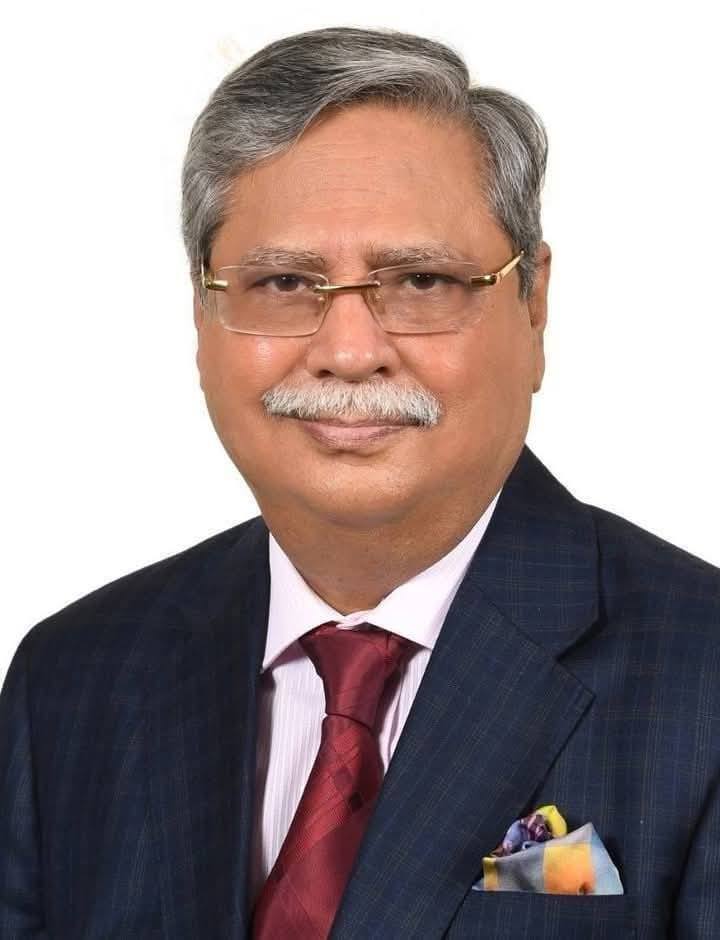
Elected unopposed in 2023 under the now-ousted Awami League administration, Shahabuddin, at 75, assumed a pivotal role during the August 2024 student-led uprising that forced Prime Minister Sheikh Hasina to take refuge in India with the help of the Bangladesh Army.
As the last remaining constitutional authority after parliament’s dissolution, he became commander-in-chief of the armed forces in a largely ceremonial capacity, with executive power ostensibly held by the prime minister and cabinet in a nation of 173 million.
Shahabuddin’s tenure, intended to span five years, now faces an abrupt end. He has indicated plans to step down midway through his term, immediately following the February 12 parliamentary election.
In a WhatsApp interview with Reuters’ Krishna N. Das on Thursday, titled “Bangladesh president, feeling ‘humiliated,’ wants to step down halfway through term,” Shahabuddin said that this decision stems from a deepening sense of sidelining by the Yunus-led regime, which he describes as having eroded his dignity and authority through deliberate acts of exclusion.
Awami League places 7 demands, announces torch procession, lockdown
Nullifying ouster plots, President Shahabuddin attends army event
Tenure of Yunus in question amid demands for his resignation before polls
Despite his position’s constitutional weight, Shahabuddin notes that Yunus has not met him for nearly seven months, his press department was stripped away, and in September, his portraits were abruptly removed from Bangladeshi embassies, consulates, and high commissions worldwide. This overnight elimination sent a chilling message, implying his own impending removal and fueling perceptions of instability.
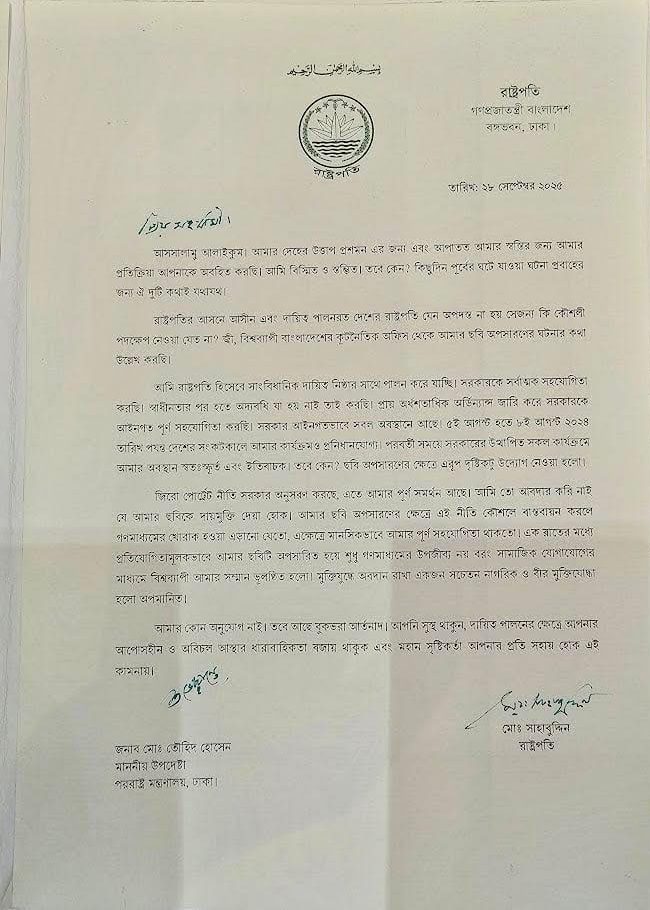
The removal of the portraits, executed without consultation, amplified his isolation on the global stage. Shahabuddin formally raised this with Yunus, but no corrective action followed. In a personal letter to Foreign Adviser, Md. Touhid Hossain, dated September 28, 2025, he conveyed shock and surprise at the incident, questioning why strategic measures were not taken to avoid disgracing the sitting president.
He emphasised his unwavering devotion to constitutional duties, including issuing over 50 ordinances to provide full legal backing to the government—actions he claims surpass precedents since independence. From August 5 to 8, 2024, during the crisis, his interventions were spontaneous and supportive, yet this support was met with public humiliation.
The letter underscores his endorsement of the government’s zero-portrait policy but laments the hasty, competitive execution that turned it into media fodder, tarnishing his reputation as a freedom fighter from the liberation war. He frames it as an insult to a conscious citizen who has contributed to the nation’s struggles, expressing a heartfelt cry without overt complaint.
This pattern of exclusion aligns with broader efforts to undermine Shahabuddin’s legitimacy, including repeated plots to force his ouster. Since the August 5, 2024, changeover, the interim government—described in critical accounts as Jamaat-backed—has pursued his resignation alongside that of Army Chief General Waker-uz-Zaman.
In late June 2025, anarchists aligned with the regime, including figures like France-based Pinaki Bhattacharya, threatened to mobilise 50,000 people to besiege Bangabhaban on July 3 and remove him. Rumours persisted of plans to declare a July Charter and suspend the constitution on August 3, 2025, aiming for absolute power and evading constitutional accountability.
Bangladesh Judiciary Under Yunus: A tale of two justices—vengeance vs impunity
From Interim Savior to Civil War Architect: Yunus’ deadly dance with ISI and Jamaat
ICT-BD: Questions and concerns about the Chief Prosecutor’s statement
The interim government’s formation itself is contested: it allegedly forged Chief Justice Obaidul Hasan’s signature on August 8, 2024, defying constitutional provisions, as no resignation letter from Hasina was ever produced. Section 57(a) of the constitution requires the prime minister to submit a resignation letter to the president for the office to become vacant, a step Sheikh Hasina could not take amid the mob’s advance toward assassination.
Shahabuddin’s interactions reveal a regime reliant on mob-driven illegitimacy. In mid-October 2024, during a conversation with Daily Manab Zamin Chief Editor Matiur Rahman Chowdhury, he clarified that on August 5, 2024, at 10:30am, Bangabhaban received a call from the prime minister’s residence indicating Hasina’s impending visit, prompting preparations.
Within an hour, a follow-up call cancelled it amid rising unrest. Lacking direct confirmation, Shahabuddin directed his military secretary to investigate, but no resignation letter materialised. Even the cabinet secretary later sought a copy, which Shahabuddin noted he was also pursuing.
To resolve lingering doubts, he sought the Supreme Court’s opinion, affirming that Hasina’s departure marked the end of her tenure, closing the debate on the matter. This episode highlights the interim government’s forgery and defiance of constitutional norms to legitimise its rise.
These ouster pressures escalated dramatically on December 2, 2025, when Shahabuddin’s verified official Facebook account was hacked, with intruders posting a single message—“#Resignation”—visible only to his friends list due to privacy settings.
The breach, occurring around 7:15pm, was swiftly addressed by the President’s Assistant Private Secretary (APS), Md. Sagar Hossain, who confirmed the cyber intrusion and urged the public not to be misled by the unauthorised content. The account was temporarily deactivated to halt further activity, and by 7:30 p.m., Shahabuddin himself issued a warning from his personal profile, alerting followers to the hack.
Officials attributed the incident to a security vulnerability and launched an investigation in coordination with Meta, emphasising that the post did not reflect any genuine intent to resign. This digital sabotage, coming amid ongoing demands for his removal from Yunus’s National Citizen Party (NCP) and aligned groups, further exemplifies the mobocratic tactics undermining his constitutional standing, transforming online spaces into battlegrounds for regime-driven narratives of illegitimacy.
Amid these pressures, Shahabuddin has maintained ties with the military, with his most recent public appearance occurring on November 21, 2025, during Armed Forces Day observances. On that morning, as supreme commander of the armed forces, he first placed a wreath at the altar of “Shikha Anirban” (the eternal flame) at Dhaka Cantonment, followed shortly by Yunus.
Army Chief General Waker-uz-Zaman, Navy Chief Admiral Mohammad Nazmul Hassan, and Air Force Chief Hasan Mahmud Khan paid tributes on behalf of their respective forces. The president and chief adviser issued separate statements marking the day, while the service chiefs paid courtesy calls on both leaders. Yunus hosted a reception for decorated freedom fighters at the cantonment’s Army Multipurpose Complex.
Earlier, Shahabuddin had attended the golden jubilee of the President Guard Regiment (PGR) at Dhaka Cantonment on July 9, 2025—delayed from its July 5 observance—nullifying ouster speculations. Welcomed by General Waker-uz-Zaman and PGR Commander, he inspected the quarter guard, signed the book, and addressed officers, praising their concentration, dedication, discipline, and professional skills.
Fact-check: Legitimacy of Yunus government in question
Fact-check: How Yunus lies about his complicity in July Conspiracy
He instructed PGR members to remain loyal to leadership and execute duties impeccably while honouring liberation war martyrs and fallen PGR soldiers, including five recent ones.
Senior officials, including Navy Chief Admiral M. Nazmul Hassan and Air Chief Marshal Hassan Mahmud Khan, attended, signalling the armed forces’ steadfast allegiance to the president. The PGR, established in 1975 by Bangabandhu Sheikh Mujibur Rahman as the Presidential Security Force and elevated to regiment status in 1982, operates under the president’s executive office, providing elite protection for VVIPs and underscoring Shahabuddin’s enduring constitutional role.
The interim regime’s actions extend to manipulated narratives around the July uprising. On August 4, 2025, a message issued under Shahabuddin’s name—amid his effective house arrest since August 5, 2024, limiting meetings to government representatives and select army officials—praised the uprising as an outburst against deprivation, misrule, corruption, and oppression.
It hailed the victory over fascist systems, called for uprooting such roots, and committed to justice for martyrs and the injured, while expressing hopes for democratic reforms and equality. However, this statement emerged against a backdrop of demands for his expulsion by Yunus’s National Citizen Party (NCP) advisers and leaders, triggered by his earlier disclosure that Hasina had not formally resigned.
Critics point to the government’s revisions to the International Crimes Tribunal Act to prosecute Hasina and Awami League figures for protester killings, while NCP, BNP, Jamaat-Shibir, and Hefazat politicians admit to arming mobs, killing police and Awami League supporters, and torching offices. Celebrations of the regime’s one-year power grab include benefits for protesters, marred by flawed lists, corruption, extortion, and arbitrary detentions of Awami League members as vengeance.
Shahabuddin’s regular contact with General Waker-uz-Zaman reinforces democratic aspirations, with the army chief explicitly rejecting power grabs and prioritising elections. No major political party has recently demanded his resignation, despite initial student calls, and polls favour the BNP and Jamaat-e-Islami. He maintains independence, unaffiliated with parties, and upholds his post until elections to honour constitutional obligations.
Yet, the cumulative weight of these events—portrait removals, ouster threats, forged legitimacies, stifled communications, cyber incursions like the December 2 hack, and increasing seclusion since his November 21 appearance—paints a presidency cornered by a mobocratic interim order that prioritises vengeance over constitutional fidelity.
 Bengali
  English