The dismal representation of women in the 13th National Parliamentary Election and referendum on February 12 underscores a broader crisis for women’s rights in Bangladesh under the partisan, unconstitutional interim government—widely criticised as a Jamaat-backed regime with Pakistani influences that has fueled rising Islamist extremism, moral policing, and unchecked violence against women.
According to Election Commission (EC) data, out of 1,981 final candidates contesting in 300 constituencies, only 81 are women—just 4.08%. This represents a sharp decline from the previous election’s 96 women candidates (out of 1,969), despite strong demands for greater female representation and commitments in the July Charter.
Party-wise, leftist groups like Bangladesh Socialist Party (Marxist) lead with 34.48% women among their candidates (10 out of 29), while major players lag: BNP has ten women out of 288 (3.47%), JaPa six out of 192 (3.12%), and NCP two out of 32 (6.25%). Jamaat-e-Islami, part of alliances contesting over 200 seats, fielded zero women candidates. Independents account for 18 women (7.22% of 249 independents), the highest single bloc.
This pathetic showing—coupled with ignored reforms, shelved commissions, rampant violence, moral policing by Islamists, and economic devastation for women workers—exposes the interim regime’s failure to protect or empower half the population. As elections approach, the low female candidacy signals not progress, but regression under a system hijacked by radical forces.
Most parties had agreed to nominate at least 5% women candidates initially, with a phased goal of reaching 33%. Yet, in this first step, political outfits have blatantly failed to honour these pledges, betraying women amid a surge in gender-based atrocities.
HRW alarmed over violence against women, girls, and minorities in Bangladesh
Violence against women, girls surges alarmingly amid rise of extremism
IMB Masna-Sulasa: Qasemee’s marketplace for women using religion
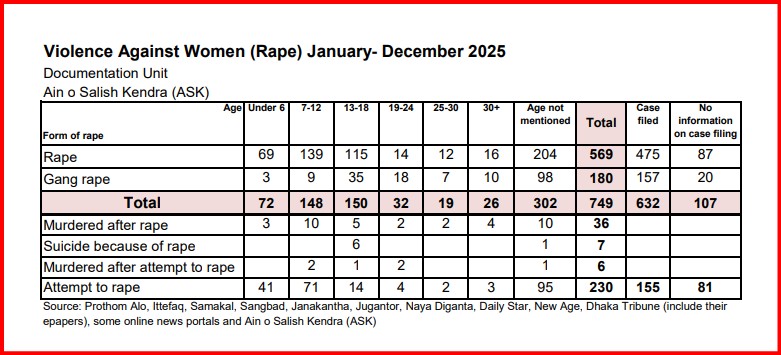
The situation for women has deteriorated alarmingly since the 2024 changeover and the rise of this interim setup. Reports from rights groups, including Ain o Salish Kendra (ASK) and international NGOs, highlight a dramatic spike in rape cases, sexual harassment, domestic violence, mob attacks, and abuse—often linked to rising moral policing by Islamist hardliners. In the first half of 2025 alone, thousands of violence-against-women cases were documented, with rape incidents surging by over 68% in some periods, including recurrent assaults on girls and minors.
Platforms like “Bangladesh against Rape and Abuse” have protested the impunity, as criminals exploit the lawlessness, with misogyny and radical elements emboldened under the regime’s watch.
Bangladeshi Women, Girls, Minorities Face Rising Violence
Islamist groups have aggressively blocked progressive reforms: Proposals from the Women’s Affairs Reform Commission—aiming for equal inheritance rights, bans on polygamy, recognition of sex workers’ rights, and broader gender equality—were shelved following massive protests by hardline religious outfits in 2025, who branded equality “suicidal” and insisted “men and women can never be equal.” This backlash has stifled women’s development initiatives and reinforced patriarchal control.
Economic fallout has compounded the misery. The ready-made garment (RMG) sector—where women dominate the workforce—has seen massive job losses due to factory closures, falling exports, rising costs, and external pressures like US tariffs. Over the past 18 months, around 250-260 factories shut down, costing more than 220,000 jobs (with estimates of over 100,000 in the last year alone), disproportionately hitting women. Broader economic stagnation has led to nearly 20 lakh jobs lost in 2023-2024, with further declines projected into 2025-2026, pushing many women into vulnerability and poverty.
Awami League protests torture of party’s women leaders, activists in prisons
Why are Yunus supporters welcoming women abusers with garlands?
Mahila Parishad, human rights groups condemn rising rape of women and girls
Regional breakdowns reveal stark disparities in women’s candidacy:
– Dhaka region: Highest at 23 women candidates, including figures like Afroza Khanam (BNP, Manikganj-3), Rokeya Akter (Insaniyat Biplob Bangladesh, Munshiganj-1), and others from parties like BSD (Marxist), JSD, Gana Adhikar Parishad, and independents.
– Cumilla region: 11 candidates, such as Rumeen Farhana (independent, Brahmanbaria-2) and others from JSD, BSD, and Islamic Front Bangladesh.
– Rajshahi region: Ten, including Toufika Dewan (BSD Marxist, Joypurhat-1) and independents.
– Mymensingh region: Nine, with candidates like Ainin Nahar (independent, Tangail-3).
– Rangpur region: Eight, including Nurun Nahar Begum (JaPa, Thakurgaon-2) and independents like Anwar Islam Rani (Rangpur-3).
– Chittagong region: Seven, featuring Jinat Akter (independent, Chittagong-2) and ethnic minority candidates like Jiruna Tripura (Khagrachhari).
– Khulna region: Seven, including Rupsha Khatun (BRP, Kushtia-3).
– Faridpur region: Four, with Shama Obayed Islam (BNP, Faridpur-2).
– Sylhet and Barishal regions: Only two each, the lowest.
 Bengali
  English