In a bold declaration from exile, Bangladesh’s former foreign minister Hasan Mahmud vowed that the Awami League would reclaim power in Dhaka under Sheikh Hasina’s leadership. Speaking at the party’s first press conference in Delhi, Mahmud lambasted the UN Office of the High Commissioner for Human Rights (OHCHR) report on the July-August 2024 protests as “highly biased,” echoing widespread criticisms from Awami League supporters and independent analyses.
Ahead of Bangladesh’s February 12 elections, where the Awami League’s political activities remain banned, the event underscored ongoing tensions.
The press conference, organised by Awami League leaders in Delhi, marked a significant moment for the party since the changeover in August 2024. Mahmud, flanked by former education minister Mohibul Hasan Chowdhury and activists like Golam Maruf Majumdar Nijhoom, head of the legal team at the International Crimes Research Foundation (ICRF), addressed reporters on the party’s future plans. Mahmud recently arrived in India from Belgium.
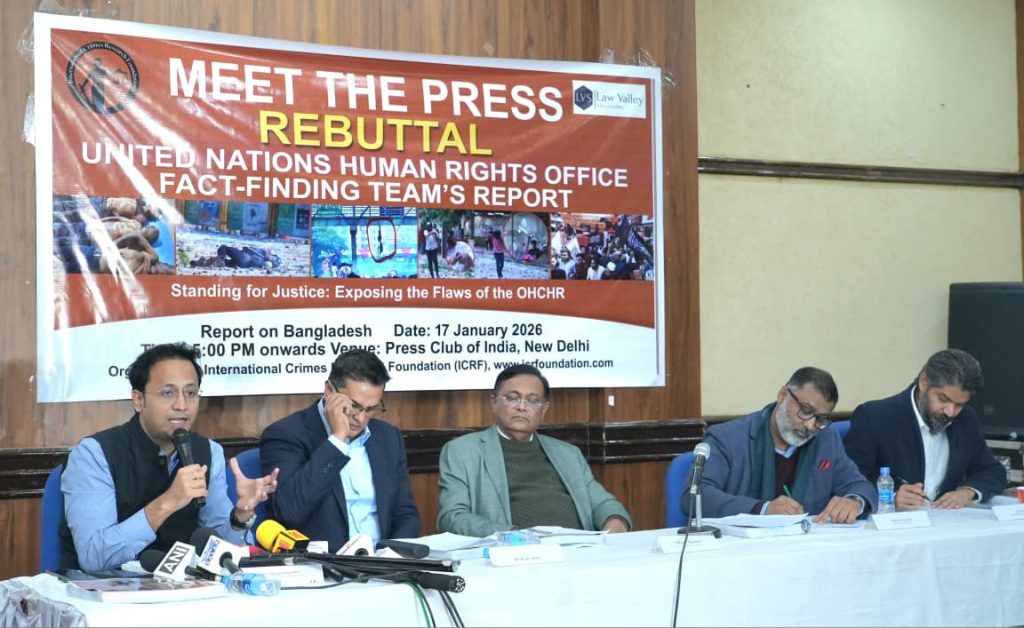
Responding to questions about forming a government in exile, Mahmud stated: “We will return to Bangladesh with Sheikh Hasina leading us to form a government.”
The gathering underscored the Awami League’s resilience, with Mahmud emphasising the party’s historical role in Bangladesh’s independence and its broad public support. He claimed the interim regime under Muhammad Yunus is “incapable of holding fair elections,” labelling the upcoming polls as “one-sided” and orchestrated to exclude the Awami League, which he says enjoys nearly 60% popular backing.
Attacks on Journalists, Minorities, and Party Members Highlighted
Mahmud pointed to a litany of abuses under the Yunus administration, including the arrest of hundreds of journalists on “flimsy charges,” raids on newspaper offices, and assaults on cultural organisations. He alleged that over one lakh Awami League members are imprisoned, with systematic attacks on minorities leading to killings and displacement. “Some one lakh Awami Leaguers are in jail, and minorities have been systematically attacked and killed after the new, illegal regime took over,” Mahmud said.
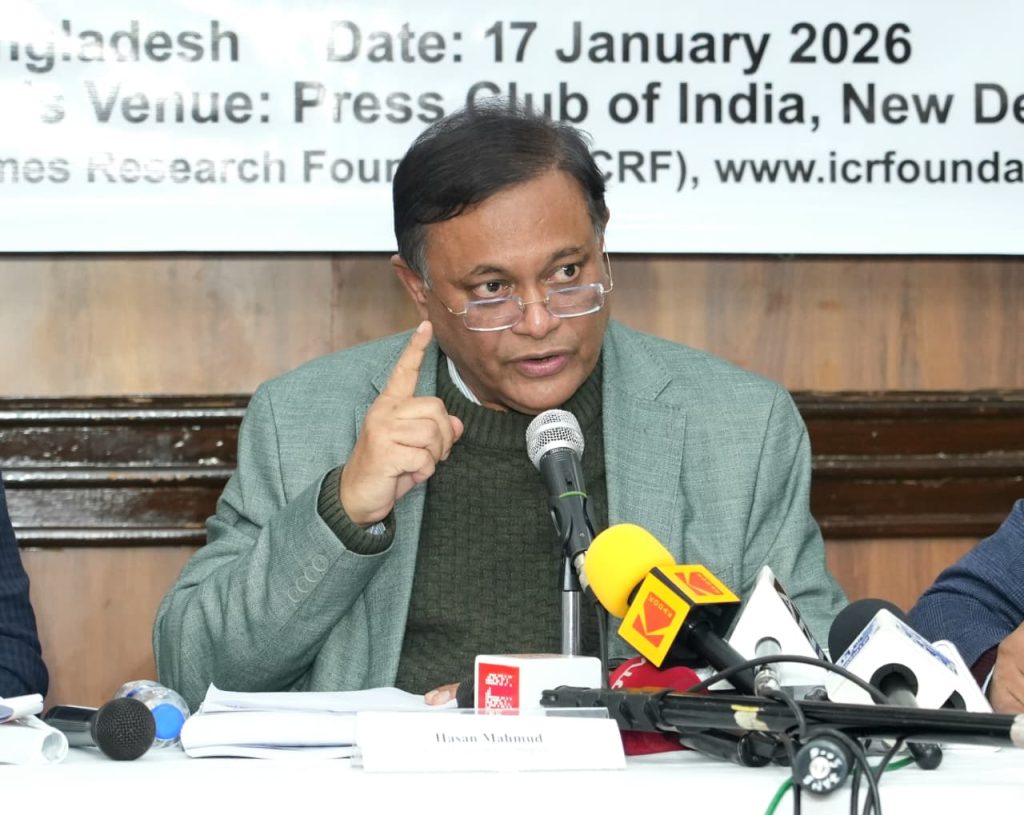
Recent reports corroborate these claims, noting eight Hindu community members killed in the past two weeks alone. The Awami League is compiling a comprehensive account of killings and atrocities since the August 2024 revolt, intending to submit findings to the OHCHR, European Union, and Commonwealth Secretariat for independent verification or action.
ICRF: OHCHR narrative is super biased, it blames Awami League for everything
Report: 528 Awami League leaders, activists killed since July 2024
ICT-BD: OHCHR Dhaka rep Huma Khan’s dubious role raises eyebrows
Adding to this, journalist Masuda Bhatti, in a detailed critique, slammed the OHCHR for ignoring post-August 15, 2024, violence, where “hundreds have been burned or beaten to death, many killed in prisons, and thousands detained without trial.” Bhatti questioned the UN’s silence on these issues, contrasting it with their reports on Gaza or Yemen, and accused the body of enabling the interim government to target Sheikh Hasina and Awami League leaders.
Elections Dismissed as ‘Arranged Farce’
Mahmud criticised the February elections as an “arranged election and hardly free or fair,” arguing that barring the Awami League denies millions their voting rights. He claimed the interim government fears the party’s popularity, leading to its deregistration under the Anti-Terrorism Act in May 2025. This echoes statements from Sheikh Hasina, who has called for a boycott and warned of potential violence if the ban persists.
Former Foreign Minister AK Abdul Momen, in a letter to UN Secretary-General Antonio Guterres dated October 20, 2025, echoed these sentiments, urging an independent probe into the OHCHR report for “factual inconsistencies” and “biased narratives.” Momen warned that the report fuels political manipulation, pushing Bangladesh toward collapse despite its development gains under Hasina.
OHCHR Report Rebutted as ‘Super Biased’
A central focus of the conference was the OHCHR’s February 2025 report, which documented serious human rights violations during the 2024 protests, including extrajudicial killings and torture by the former government and Awami League affiliates. The UN found “reasonable grounds” for crimes against humanity, estimating over 1,000 deaths and urging accountability.
Ex-FM Momen bins OHCHR report, asks UN chief to reinvestigate violence
Journalist Masuda Bhatti post-mortems OHCHR’s cooked report
Bangladesh Rights Abuses: JMBF president meets OHCHR reps in Geneva
However, Mahmud and allies dismissed it as “one-sided,” overlooking violence against Awami League members and security forces. He claimed the report failed to account for nearly 3,000 policemen killed, including an entire station set on fire with 40 officers inside. “Many of those killed died of sniper rifle shots using [7.62] calibres not held by Bangladeshi security forces, hinting at foreign or enemy elements,” Mahmud alleged.
The ICRF team, under Nijhoom Majumder, prepared a 192-page rebuttal (plus 305-page appendix) in October 2025, labelling the OHCHR narrative “super biased.” Majumder noted the UN ignored statements from ministers, MPs, and police, relying instead on “primary and secondary sources with countless discrepancies.” The rebuttal, crafted by 40 barristers, journalists, and activists, accuses the OHCHR of aligning with Jamaat-Shibir and “July terrorists.”
The Global Center for Democratic Governance (GCDG) September 2025 analysis similarly called the report a “politically framed narrative,” marred by biases and omissions of protester violence. Momen’s letter highlighted inflated death tolls (UN’s 1,400 vs. local figures of 657-824, including unrelated deaths) and omitted facts like police killings, an indemnity decree protecting protesters, and the release of terrorists.
Sheikh Hasina challenged the OHCHR to prove 1,400 deaths, calling for exhumations and forensics, and blamed Yunus for “meticulously designed” killings using non-standard bullets. Bhatti’s “post-mortem” critiqued the report’s structure, noting it ignored attacks on minorities, army involvement, and protester weapons, while distorting Hasina’s statements for political purposes.
ICT-BD: UK-based legal expert challenges verdict against Sheikh Hasina
Under Yunus, law and order in Bangladesh at its worst in history
Liberation War Legacy Under Scrutiny: Yunus’ revisions spark controversy
These rebuttals contrast with the OHCHR’s findings, based on 250+ interviews, which urged ICC referral and reforms. Critics like the ICRF plan global dissemination to expose the UN “distortions.”
Mahmud expressed disappointment in the UN, once seen as a “last hope,” but accused Volker Türk of proceeding on Yunus’s request without a Security Council resolution, describing Yunus as a “friend.” He alleged that no stakeholders were consulted and data lacked provenance, with those listed as “dead” later found alive.
Chowdhury said the report was “totally fabricated, biased, one-sided and meant to protect the regime” of Yunus. He said: “The UN started from the presumption that the Awami League government was guilty.”
The Awami League leaders noted that such investigations by the UN are usually carried out only after the Security Council passes a resolution but pointed out that in this instance, Türk convened a team to carry out a probe on the basis of a request from Yunus. While Chowdhury acknowledged that there were excesses by the security forces while dealing with the student-led protests, he said the UN report made no mention of the hundreds of police personnel killed or reported missing during the demonstrations or the attacks on Awami League workers and leaders.
The Awami League has documented 528 leaders and activists killed since July 2024, plus 38 custodial deaths and the arbitrary arrest of over 4,00,000 leaders and workers in around 2,000 false and fabricated cases. Sheikh Hasina has condemned indemnity for protester crimes and massive corruption by Yunus and his gang and vowed justice upon return.
 Bengali
  English