Tarique Rahman’s BNP has firmly refused to take the oath as members of the so-called Constitution Reform Council, opting instead to prioritise reforms aligned with their party manifesto over the contentious July Charter aggressively promoted by the Yunus-Jamaat clique.
This move underscores BNP’s unwavering commitment to constitutional sanctity and democratic values, setting a powerful example in Bangladesh’s turbulent political landscape.
The decision comes on the heels of the recently concluded 13th Jatiya Sangsad elections, where BNP secured significant victories, including in key constituencies like Cox’s Bazar-1.
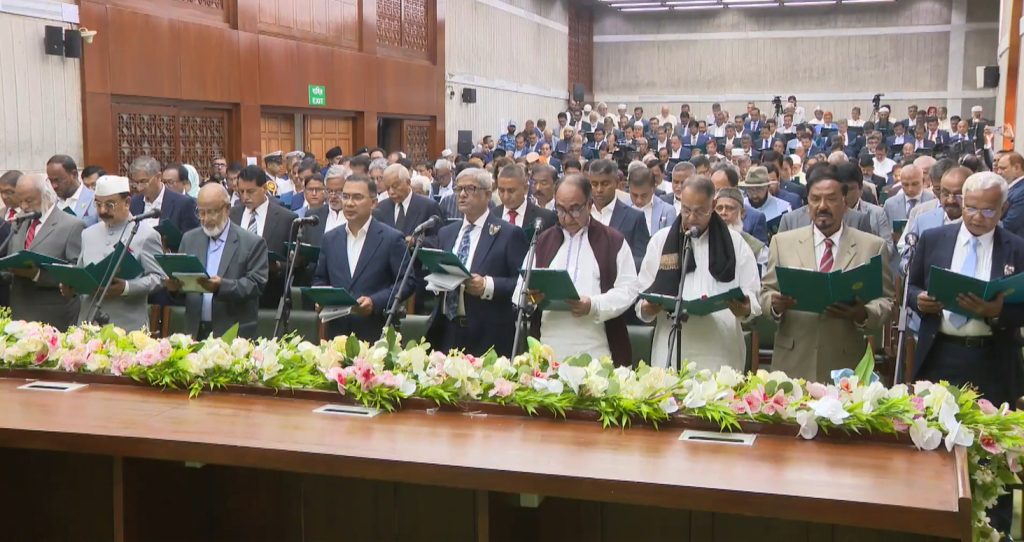
Expelled from BNP, Rumeen Farhana took her oath as an independent MP, but she left the complex when the Jamaat leaders were preparing for the second oath. BNP MP Ishraque Hossain followed her and left the room.
Newly elected MPs from the party, led by figures such as Standing Committee Member Salauddin Ahmed, took their oaths as parliamentarians but deliberately abstained from the additional pledge for the reform council. This strategic refusal highlights BNP’s resolve to implement changes through legitimate parliamentary processes, rather than succumbing to what they view as an imposed and extraconstitutional framework.
BNP’s Landslide Victory: A cause for concern?
Midnight Election: TIB reveals 21.4% fake vote cast in 70 polling centres
Midnight Election: TIB reveals 21.4% fake vote cast in 70 polling centres
Salauddin Ahmed, a vocal advocate for constitutional adherence, articulated the party’s stance with clarity and conviction during a press interaction following the inaugural meeting of BNP’s parliamentary group at the Jatiya Sangsad Bhaban.
“The July National Charter was signed as a political agreement, and we are committed to honouring it in letter and spirit,” Ahmed stated. However, he emphasised that true reflection of the people’s will, as ostensibly captured in the referendum, requires first entering Parliament to enact necessary laws and constitutional amendments.
Salauddin further critiqued the referendum process, labelling it unconstitutional and pointing out a glaring procedural flaw: there is no provision in the existing Constitution specifying who has the authority to administer the oath for the reform council.
“According to the current Constitution, the Chief Election Commissioner (CEC) lacks the jurisdiction to administer oaths for the Constitution Reform Council,” Salauddin remarked.
Awami League grassroots leaders reclaim party offices across country
Torch The Mir Jafar: Burning poster of fascist Yunus at Dhaka University
Police assault, detain DU professor, supporters at Dhanmondi-32
He noted that the CEC had not even approached BNP members for this purpose, and the party had no intention of participating in such an irregular ceremony. “Everything must be conducted constitutionally. We have come this far by following constitutional methods, and in the future, we will govern the state constitutionally,” he affirmed, attributing the directive to BNP Chairperson Tarique Rahman.
This principled boycott has drawn praise from legal and political observers who see it as a bulwark against potential overreach. Adding to the momentum, a writ petition filed today by Supreme Court lawyer ABM Ataul Majid Touhid challenges the validity of the February 12 referendum results, seeking their suspension and annulment.
The petition, set for a hearing next week before a High Court bench led by Justice Fatema Najib, argues that the referendum’s conduct and gazette notification on February 13 were fundamentally flawed. This legal action is being hailed as a courageous step toward accountability, reinforcing BNP’s narrative that the entire process lacks constitutional legitimacy.
Sheikh Hasina vows prosecution of Yunus, Election Commission over sham polls
Sajeeb Wazed: Awami League will always be a factor, let the honeymoon period end
6 radical Islamist mob leaders of Yunus’ NCP become MP, pose threat to democracy
Compounding these concerns are widespread reports of irregularities in the election and vote-counting processes. Critics, including independent monitors, have highlighted discrepancies in voter turnout figures, allegations of ballot stuffing, and inconsistencies in the tallying of “Yes” and “No” votes in the referendum.
Official data claims over 40 million “Yes” votes against roughly 22 million “No” votes, but sceptics point to suppressed voter participation and manipulated results, especially in opposition strongholds. These irregularities not only undermine the referendum’s credibility but also amplify BNP’s call for reforms grounded in transparency and their manifesto promises, such as strengthening democratic institutions and ensuring fair governance.
In contrast, voices like Badiul Alam Majumdar, a former election reform commission chief and member of the National Consensus Commission, have defended the process, claiming it reflects the people’s sovereign will under Article 7(1) of the Constitution.
However, such defenses ring hollow amid the Jamaat-e-Islami Amir Dr. Shafiqur Rahman’s sharp rebuke of the BNP’s stance as a disregard for the July uprising. Rahman accused the “government party” of ignoring public aspirations, yet his comments inadvertently spotlight the divisions that BNP’s principled position seeks to bridge through constitutional means.
 Bengali
  English