As tensions simmer across the border in Bangladesh following the violent 2024 anti-Hasina protests, a chilling figure from that chaos has surfaced in India: Ahmed Reza Hasan Mahdi, also known as Mahdi Hasan, the self-confessed killer of a Hindu police officer. Activists and intelligence watchers are raising alarms that Mahdi, a district-level leader of Bangladesh’s Anti-Discrimination Student Movement (SAD), is using Indian soil as a stepping stone to evade justice.
With his passport details circulating online and reports placing him in Paharganj, New Delhi, awaiting a Portuguese visa, the question looms large: Why is India harbouring a man who openly boasted of burning a police officer alive?
Mahdi’s notoriety stems from a viral video recorded in early January 2026 at Shayestaganj Police Station in Habiganj, Bangladesh. In the footage, he confronts Officer-in-Charge Abul Kalam over the detention of a former Chhatra League activist, brazenly declaring,
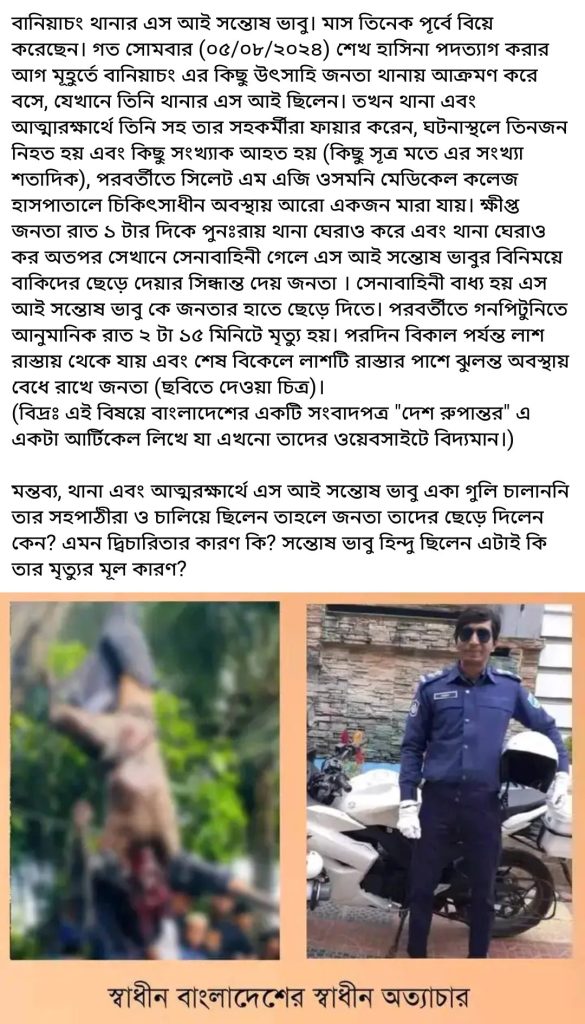
“We burned down Baniachong Police Station, and we set fire to SI Santosh.” This confession refers to the horrific August 5, 2024, attack on Baniachang Police Station during the jihadist-led uprising that toppled Sheikh Hasina’s government. Sub-Inspector Santosh Chowdhury, a Hindu officer, was lynched by a mob, his body set ablaze and hung from a tree in a barbaric display of communal violence.
Despite the gravity of his admission, Mahdi was detained by Bangladeshi police on January 3, 2026, but only on charges of threatening officers and obstructing duties—not murder. He was released on bail the next day amid protests from SAD supporters, who demanded blanket immunity for all participants in the July movement.
Critics argue this leniency under the interim government led by Muhammad Yunus reflects a troubling indulgence toward radical elements, allowing figures like Mahdi to slip away.
Now, credible reports confirm Mahdi’s presence in India. Social media posts, including those from journalists and activists, reveal he entered the country—possibly on a fake visa—and was spotted at the VFS Global centre in Connaught Place, Delhi, submitting fingerprints for a European work permit visa. His passport number, A08435001, issued on December 10, 2023, has been widely shared, along with images of his documents and sightings at the “Dhakiya” restaurant in Paharganj. One post alleges he’s plotting a terrorist act on behalf of a Pakistani outfit before fleeing to Portugal.
Indian authorities, including the National Investigation Agency (NIA) and Delhi Police, have been tagged in these pleas for action. “Attention Indian authorities! Please arrest this self-confessed killer of a Hindu police officer,” urges one viral thread, emphasising Mahdi’s role in the 2024 jihadist coup. Another highlights his embassy visit, questioning how a wanted radical gained entry.
This isn’t just a bilateral issue; it’s a matter of India’s security doctrine. The country has long positioned itself as a bulwark against terrorism, extraditing or detaining fugitives from neighbouring nations. Allowing Mahdi to use India as a transit hub undermines that stance, especially amid rising concerns over cross-border radicalism. Bangladesh’s protests saw targeted attacks on Hindus, with police stations torched and officers killed in what many describe as jihadist fervour. Mahdi’s boasts aren’t isolated; they echo a pattern of unrepentant violence that could inspire similar acts here.
Activists demand swift intervention: track his movements via the leaked passport, detain him under anti-terror laws, and coordinate with Bangladeshi authorities for extradition. As one post warns, “Big question: How did Mahdi Hasan enter India?” Ignoring these risks turns India into a refuge for those who glorify murder.
The Indian government must act decisively—Mahdi’s case tests whether India will remain vigilant or inadvertently shield those who threaten regional stability. For the sake of justice—and the memory of SI Santosh Chowdhury—arrest him now.
 Bengali
  English