A virtually non-existent NGO operating out of a single room in its executive director’s home has been authorised by the Election Commission (EC) to deploy more than 10,000 observers—the highest number granted to any domestic group—for the February 12 national parliamentary election and referendum.
The organisation, People’s Association for Social Advancement (PASHA), is based in Bormpur village, Chunarughat upazila, Habiganj district. Its executive director, Syed Humayun Kabir, effectively runs the entity single-handedly from his residence, reveals the daily Prothom Alo.
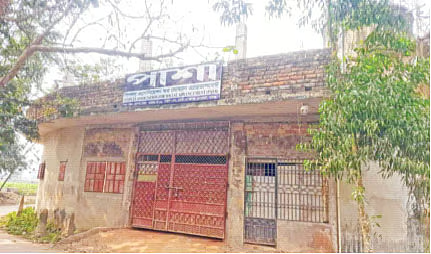
Despite having no apparent permanent staff, no active projects, and a history of operating from rented or makeshift spaces, PASHA has received approval for 10,559 observers—representing nearly 19% of the total 55,454 domestic observers permitted by the EC across 81 local organisations.
An investigation by Prothom Alo revealed that PASHA’s office is little more than a signboard attached to Kabir’s house. Local residents confirmed the premises function as a family home rather than an institutional office. Neighbours described it as a residential property with no visible NGO activity. Kabir himself acknowledged that PASHA currently has no ongoing projects and primarily acts as a “supporting partner” to other NGOs.
Bangladesh’s 1,675 eminent citizens demand halt to election, referendum
135 Bangladeshi journalists demand halt to one-sided election process
Yunus Backs Jihadists: Hindus butchered with impunity as sham elections loom
He claimed the observers would be deployed on a voluntary basis or funded by donor applications (particularly to the European Union), though no training has been provided except possibly for team leaders.
PASHA has been cleared to place observers in 127 parliamentary constituencies (Kabir claimed 119 with 10,792 observers). In some areas, particularly in Sylhet division (Moulvibazar, Habiganj, Sunamganj), northern districts (Lalmonirhat, Rangpur, Kurigram, Gaibandha, Naogaon), and others, PASHA dominates observer allocations. For example:
– Moulvibazar-3: 305 observers (highest single allocation)
– Moulvibazar-1: 273 out of 286 total observers
– Moulvibazar-2: 241 out of 277
– Lalmonirhat-1: 100 out of 257
– Naogaon-1: 139 out of 185
Critics, including pro-Yunus NGO Shushashoner Jonno Nagorik (SHUJON), have questioned the EC’s vetting process.
Interview With AP: Sheikh Hasina denounces election as fundamentally flawed
The February 12 Staged Election: A Champion’s Trophy of fraud?
Understanding Bangladesh’s February 12 election
SHUJAN Executive Director Badiul Alam Majumdar noted that the commission appears to have approved registrations without adequate scrutiny of organisational capacity or credibility. He pointed out that many approved groups are small, under-resourced, or operate from private residences—echoing a September 2025 Prothom Alo investigation that found similar issues with 43 of the initially shortlisted 73 organisations.
PASHA’s registration history adds to the concerns. Registered with the Department of Social Services in 1993 for activities like tree plantation, anti-dowry campaigns, and free educational material distribution, the organisation has not sought committee approvals since then. Locally, it has faced controversies, including allegations of past misconduct in Habiganj town (leading to relocation) and claims of selling observer cards for nominal fees in previous elections.
The EC, under the Jamaat-Yunus clique’s influence, has been accused of deliberately favouring pliable or partisan entities to facilitate election manipulation. Observers play a critical role: they can access polling stations (except secret ballot booths), witness vote counting, and submit post-election reports. With such large numbers deployed by a single dubious group, critics fear PASHA’s observers could be used to legitimise irregularities.
Sheikh Hasina slams fascist Yunus for making Bangladesh a safe haven for extremists
Sajeeb Wazed Joy warns of Islamist takeover, urges international intervention
Sheikh Hasina reveals her priorities after return to Bangladesh
The broader context raises serious alarms about rigging plans orchestrated by the Jamaat-controlled Election Commission and the Yunus-led interim regime. Reports and opposition sources allege systematic manipulation strategies, including:
– Mass transfer of Jamaat voters to “suitable” polling areas to inflate turnout in targeted constituencies.
– Production and distribution of fake ballots and official seals by Jamaat members.
– Tampering with postal ballots in Bahrain, Oman and Kuwait to favour Jamaat-aligned candidates.
– Deployment of partisan “observers” to overlook or cover up booth capturing, ballot stuffing, and intimidation.
These tactics, combined with the exclusion of major opposition parties (notably the Awami League), widespread arrests of political opponents, and control over state machinery, have led to accusations that the February 12 process is designed to deliver a predetermined outcome. The EC’s decision to grant disproportionate observer slots to a one-man outfit with questionable credentials is seen as part of this broader scheme to create a veneer of legitimacy while enabling fraud.
Interview With ThePrint: Sheikh Hasina exposes Yunus’ authoritarianism
What is in the indemnity ordinance issued by Yunus for July anarchists?
EC Senior Secretary Akhtar Ahmed defended the approvals, stating that organisations met the necessary criteria and submitted deployment plans without apparent discrepancies. He invited evidence of irregularities for further action. However, transparency advocates argue the process lacks rigour, especially given the regime’s track record of institutional capture.
This development comes amid escalating domestic and international scepticism over the credibility of the upcoming polls and referendum, with port workers, civil society groups, and political parties continuing to protest what they call anti-national and fraudulent manoeuvres by the interim authorities.
 Bengali
  English