In an exclusive interview conducted on February 20 at Bangabhaban by Kaler Kantho Executive Editor Haidar Ali and Special Correspondent Zainal Abedin, President Mohammed Shahabuddin spoke candidly about his one-and-a-half-year “confinement” under the interim government, expressing relief at its end.
He reported being well for about a week, smiling enigmatically when asked about prior health. During the period, he faced conspiracies without involvement in discussions, remaining firm to foil plots against law and order and constitutional continuity. Protests demanding his resignation did not break him; he was prepared to become a historical chapter if needed.
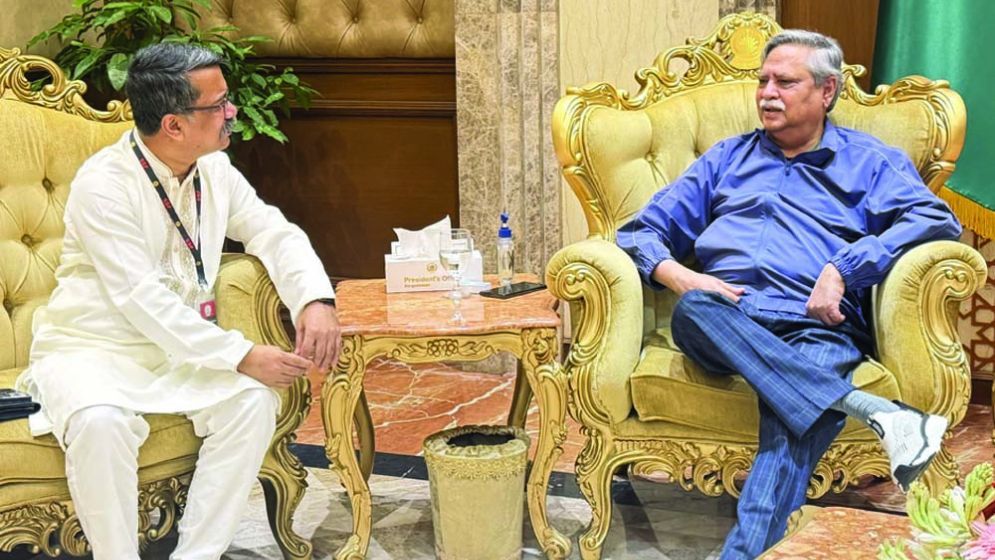
He detailed the October 22, 2024, siege, hired agitators, and army intervention. The BNP’s support was crucial, as was the armed forces’ and diplomacy’s opposition to unlawful removal. Chief Adviser Dr. Muhammad Yunus never coordinated, blocked visits, and omitted him from publications. The Press Wing dismantling followed a journalist meeting, preventing communications—even for national days like February 21, though he hoped his message would appear that Saturday (February 21, 2026).
Interview With Reuters: President Shahabuddin says his voice has been stifled
Nullifying ouster plots, President Shahabuddin attends army event
Tenure of Yunus in question amid demands for his resignation before polls
Shahabuddin swore in three governments, underscoring his role, and remained steadfast, crediting divine will, BNP, military, and diplomacy for his resilience.
The Onset Of The Crisis
In August 2024, Bangladesh underwent a dramatic political upheaval during a student-led uprising that forced Prime Minister Sheikh Hasina to flee to India with the assistance of the Bangladesh Army. As the last remaining constitutional authority following the dissolution of parliament, President Shahabuddin, then 75 years old and elected unopposed in 2023 under the Awami League administration, assumed a pivotal role. He became the commander-in-chief of the armed forces in a largely ceremonial capacity, while executive power was ostensibly held by the interim government led by Muhammad Yunus in a nation of 173 million people.
On August 5, 2024, at around 10:30 AM, Bangabhaban received a call from the Prime Minister’s residence indicating Hasina’s impending visit, prompting preparations. However, within an hour, a follow-up call cancelled it amid escalating unrest. Shahabuddin directed his military secretary to investigate, but no formal resignation letter from Sheikh Hasina ever materialised, even when the cabinet secretary later sought a copy. To resolve doubts, Shahabuddin sought the Supreme Court’s opinion, which affirmed that Hasina’s departure marked the end of her tenure.
The interim government’s formation was contested, with allegations that it forged Chief Justice Obaidul Hasan’s signature on August 8, 2024, defying constitutional provisions under Section 57(a), which requires the prime minister to submit a resignation letter to the president. Critics described the regime as Jamaat-backed, relying on mob-driven illegitimacy.
Bangladesh Judiciary Under Yunus: A tale of two justices—vengeance vs impunity
From Interim Savior to Civil War Architect: Yunus’ deadly dance with ISI and Jamaat
ICT-BD: Questions and concerns about the Chief Prosecutor’s statement
From August 5 to 8, Shahabuddin issued over 50 ordinances to provide legal backing to the new government, actions he later claimed surpassed precedents since independence. However, he soon found himself effectively under house arrest, limiting meetings to government representatives and select army officials.
On August 4, 2025—amid this seclusion—a message issued under Shahabuddin’s name praised the uprising as an outburst against deprivation, misrule, corruption, and oppression. It hailed the victory over fascist systems, called for uprooting such roots, and committed to justice for martyrs and the injured, while expressing hopes for democratic reforms and equality. This statement emerged against demands for his expulsion by Yunus’ National Citizen Party (NCP) advisers and leaders, triggered by his disclosure that Hasina had not formally resigned.
Plots And Protests
Since the August 2024 changeover, Shahabuddin faced repeated plots to force his ouster. Numerous conspiracies aimed to unseat him through unconstitutional means, including efforts to create a constitutional vacuum and permanently destroy law and order. He described enduring a “storm” over the one-and-a-half-year period under the interim government, during which he was not part of any discussions but was targeted by various groups.
On October 22, 2024, Bangabhaban was surrounded by protesters from parties, platforms, and alliances created overnight, many suspected to be hired individuals funded mysteriously. The Army’s Ninth Division provided three layers of security. A young woman jumped over a barbed-wire fence, lay down after sound grenades were used, and posed for photographs, which Shahabuddin viewed as blackmail. Female police and army personnel eventually carried her away.
Fact-check: Legitimacy of Yunus government in question
Fact-check: How Yunus lies about his complicity in July Conspiracy
That night, crowds attempted to loot Bangabhaban, but the armed forces brought the situation under control by around 2am or 3am. Nahid Islam, then an information adviser and a leader of the Anti-Discrimination Student Movement (ADSM), called Shahabuddin to clarify that the agitators were not affiliated with them and efforts were underway to disperse them.
Further plots included an attempt to install a former Chief Justice as president through unconstitutional means; an adviser met him for hours, but the judge refused, citing impropriety. Shahabuddin learned of this through judicial circles, given his background in the judiciary.
In late June 2025, anarchists aligned with the regime, including France-based anarchist Pinaki Bhattacharya, threatened to mobilise 50,000 people to besiege Bangabhaban on July 3 and remove him. Rumours circulated of plans to declare a July Charter and suspend the constitution on August 3, 2025, to seize absolute power.
Protests demanding his resignation included marches and demonstrations, but Shahabuddin remained firm, stating he would shed his blood at Bangabhaban if necessary to uphold constitutional continuity. He credited Allah’s will and his determination for withstanding these pressures. Even within the interim government, under pressure from uprising leaders, steps were taken to remove him, with political parties discussing it extensively. At one point, a majority might have formed against him, but it failed due to opposition from the BNP and its allies.
Strained Relations With Yunus Regime
Shahabuddin’s relationship with Dr. Yunus was markedly strained. He initiated the formation of the interim government but was subsequently sidelined. He never visited him, did not consult him on key matters, and travelled abroad 14 or 15 times without briefing him, violating constitutional obligations. Even regarding a recent agreement with the United States before the elections, Shahabuddin was not informed.
US Ambassador Christensen presents credentials to President Shahabuddin
Hypothetical threat to Bangabhaban: State-linked political extremism and radical militancy
Major Reshuffle: BNP purges pro-Jamaat officers amid rumour of army chief’s ouster
Two foreign visits—one to Kosovo and another to Qatar—were blocked. For Qatar, a draft letter falsely stated he was too busy; he protested the Foreign Ministry’s discourteous conduct but received no reply.
His portrait was removed from Bangladesh missions abroad overnight in September 2025, breaking long-standing practice and implying his impending removal.
In a personal letter to the then foreign adviser, Md. Touhid Hossain, dated September 28, 2025, Shahabuddin expressed shock, emphasising his devotion to constitutional duties and framing it as an insult to a freedom fighter from the Liberation War.
National commemorative publications omitted his message and photograph. After meeting the Dhaka Reporters Unity committee post-election victory—a routine courtesy call—the Chief Adviser’s Press Wing aggressively investigated, leading to the removal of Bangabhaban’s entire Press Wing: the Press Secretary, Deputy Press Secretary, Assistant Press Secretary, and two long-serving photographers. This dismantled the wing, preventing press releases or congratulatory messages, rendering the presidency “handicapped.”
Shahabuddin personally phoned officials like the Cabinet Secretary, but to no avail, viewing it as an effort to prevent his exposure to the public.
The regime’s actions extended to revising the International Crimes Tribunal Act to prosecute Hasina and Awami League figures, while ignoring admissions from NCP, BNP, Jamaat-Shibir, and Hefazat politicians about arming mobs and violence. Celebrations of the regime’s one-year anniversary included flawed benefits for protesters, marred by corruption and arbitrary detentions.
Support Systems: BNP, armed forces, and diplomacy
Despite isolation, Shahabuddin found support from the BNP’s top leadership, who expressed commitment to constitutional continuity. He developed a positive view of BNP Chairman Tarique Rahman, describing him as sincere and cordial, with the BNP providing 100% cooperation during crises. Senior BNP leaders assured opposition to unconstitutional removal, helping foil initiatives.
Major Reshuffle: BNP purges pro-Jamaat officers amid rumour of army chief’s ouster
Why the US trade deal exposes Bangladesh to greater vulnerability
Custodial Death: Will the BNP investigate silent killing of Awami League members?
The armed forces offered full backing, telling him that as Supreme Commander, his defeat would be theirs; they would not allow unlawful acts. Diplomatic circles opposed his removal through unconstitutional means, providing additional strength.
Shahabuddin maintained ties with the military, attending the golden jubilee of the President Guard Regiment (PGR) on July 9, 2025 (delayed from July 5), where he was welcomed by Army Chief General Waker-uz-Zaman. He inspected the quarter guard, praised the regiment’s dedication, and instructed loyalty to leadership while honouring martyrs. Senior officials like the Navy and Air Force Chiefs attended, signaling allegiance. The PGR, established in 1975 and elevated in 1982, provides elite VVIP protection under the president’s office.
On November 21, 2025, for Armed Forces Day, Shahabuddin placed a wreath at the “Shikha Anirban” eternal flame, followed by Yunus. Service chiefs paid tributes and courtesy calls, with Yunus hosting a reception. Regular contact with General Waker-uz-Zaman reinforced democratic aspirations, with the army chief rejecting power grabs and prioritising elections.
The Reuters Interview
In a rare public expression of distress, Shahabuddin gave a WhatsApp interview to Reuters’ Krishna N. Das on December 11, 2025, titled “Bangladesh president, feeling ‘humiliated,’ wants to step down halfway through term.” He articulated profound feelings of humiliation and marginalisation under Yunus’ interim government, which he said eroded his dignity through deliberate exclusion.
Debapriya’s call for audit into deals under Yunus regime gains momentum
Jamaat’s 77 seats signal continuation of militancy, mob violence under BNP rule
Shahabuddin noted Yunus had not met him for nearly seven months, his press department was stripped, and portraits were removed from embassies without consultation, amplifying isolation. He planned to step down midway through his five-year tenure, immediately after the February 12, 2026, parliamentary election, due to this sidelining.
He emphasised issuing ordinances for legal backing and spontaneous support during the August crisis, yet met with public humiliation. The letter to the Foreign Adviser lamented the hasty portrait removal as media fodder, tarnishing his reputation. He maintained independence, unaffiliated with parties, and upheld his post until elections for constitutional obligations.
On December 2, 2025, his official Facebook account was hacked around 7:15pm, posting “#Resignation” visible only to friends. His assistant private secretary confirmed the intrusion, deactivated the account, and Shahabuddin warned followers from his personal profile. Officials coordinated with Meta for the investigation, attributing it to security vulnerabilities amid demands from NCP and allies.
 English
  Bengali