On December 2, 2025, Bangladesh’s interim government took an extraordinary step: it declared former Prime Minister Begum Khaleda Zia a “Very Very Important Person” (VVIP). The decision, made in a special meeting of the Advisory Council at the state guest house Jamuna, means that the 80-year-old BNP chairperson—currently undergoing treatment at Evercare Hospital in Dhaka—will now receive the same level of protection afforded to the President, Prime Minister, or Chief Adviser.
That protection comes from one agency above all others: the Special Security Force (SSF).
Political observers are surprised that Khaleda Zia has been given VIP status when her son, Tarique Rahman, wants it upon his return from the UK after 17 years. Tarique stated on November 29 that he could not unilaterally decide to return to his critically ill mother’s bedside due to unspecified “political realities,” despite the interim government publicly declaring there are “no restrictions or objections whatsoever” to his homecoming.
As of Tuesday evening, no confirmed travel plans for Tarique Rahman have been announced, and the BNP continues to treat Khaleda Zia’s stable but closely monitored condition as the nation’s focal point of concern and prayer.
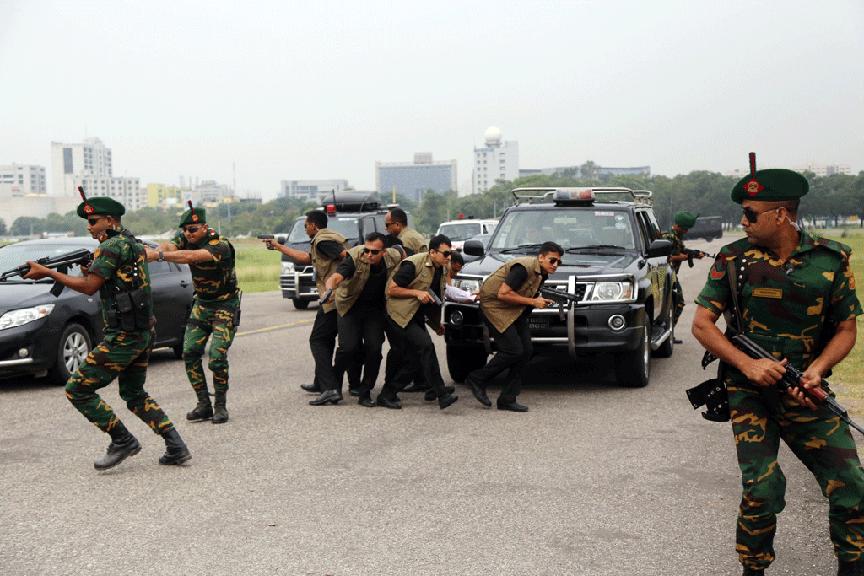
In Bangladesh, few institutions carry the mystique, firepower, and legal authority of the SSF. Created by the Special Security Force Act of 2021 (amended 2021), it is the country’s ultimate close-protection and counter-assault unit—a hybrid of the US Secret Service, Britain’s Royalty and Specialist Protection command, and an elite counter-terrorism strike force rolled into one.
Unprecedented Legal Powers
The SSF law is blunt. Its officers have nationwide jurisdiction and powers that exceed those of regular police:
Khaleda Zia gets VVIP status and SSF protection as Tarique notices invisible threat
Why Tarique Rahman still cannot come home after 17 years
Arafat doubts Tarique’s expertise in governance, questions income source
– They can arrest without a warrant anyone they reasonably believe poses a threat to a protectee.
– If a suspect resists arrest or attempts to flee, SSF officers may use “all means necessary”—including, after due warning, lethal force that may result in death.
– Every law enforcement, intelligence, and defense agency in the country is legally obliged to provide immediate assistance when the SSF requests it.
– Intelligence agencies must instantly share any information that could affect the physical safety of the President, Prime Minister, Chief Adviser, or declared VVIPs.
In short, when the SSF is guarding someone, it effectively becomes the most powerful law enforcement entity in Bangladesh for the duration of that assignment.
Who Gets SSF Protection?
By law, automatic SSF coverage goes to:
– The President
– The Prime Minister (or, in the current interim setup, the Chief Adviser)
– Heads of state and government visiting Bangladesh
– Any person whom the government formally declares a VVIP through a gazette notification
2001-06: How dangerous was Tarique Rahman?
Khaleda Zia’s case is unusual. As of December 2, 2025, no gazette notification had been published, yet the Advisory Council’s decision immediately activated SSF coverage alongside the President’s Guard Regiment (PGR). Sources say the formal gazette is expected within days.
The Men and the Machines
The SSF is drawn from the Army, Navy, Air Force, Police, and Ansar, but once inside the force, its members operate under a separate chain of command that reports ultimately to the Prime Minister’s Office.
Its operators are armed and equipped to an elite standard rarely seen elsewhere in the Bangladeshi security apparatus.
Small arms (confirmed in service with SSF close-protection and counter-assault teams):
– HK416A5 5.56mm assault rifle—the primary weapon of the most elite tier
– M4A1 carbines with SOPMOD upgrades
– M240 7.62mm general-purpose machine guns
– Heckler & Koch MP5 and MP7 sub-machine guns
– Glock 17/19 and SIG Sauer P320 pistols
– Benelli M4 and Remington 870 shotguns
– Accuracy International AXMC and Sako TRG-42 sniper rifles
– Non-lethal options, including FN 303 launchers and Taser X26P
Armoured and specialist vehicles:
– Otokar Cobra II 4×4 light armored vehicles—many fitted with Turkish-made KESKİN remote weapon stations (12.7mm or 40mm grenade launcher)
– International MaxxPro MRAPs (mine-resistant, ambush-protected)
– Ford F-550-based armoured SUVs used for low-profile movements
– Toyota Land Cruiser 200 series with Level B6/B7 armour packages
– IAG Guardian and Streit Python APCs
– BMW high-security 7-series and Mercedes S-Class Guard limousines for the highest protectees
– Bell 407 and Mi-17 helicopters on standby for emergency extraction
The SSF also maintains a little-publicised counter-assault team (CAT) capable of hostage rescue and complex attacks on protected sites — essentially Bangladesh’s Tier-1 VIP protection strike force.
Layers Upon Layers
Even with the SSF in place, protection is never a single agency. Khaleda Zia, for example, will continue to have:
Sheikh Hasina vows ‘no mercy, full justice’ for jail killings and nationwide atrocities
The Sunday Guardian: Yunus turned public benevolence into private dominion
Foreign powers out to change party leadership, Sajeeb Wazed Joy tells BBC Bangla
– President’s Guard Regiment (PGR) troops for static site security
– Police Special Security and Protection Battalion (SPBn)
– Detective Branch and Special Branch plainclothes teams
– National Security Intelligence (NSI) and Directorate General of Forces Intelligence (DGFI) threat-monitoring cells
Yet it is the SSF that sits at the very center—the final, non-negotiable shield.
A Force Built for Crisis
The SSF was dramatically expanded and re-equipped after the 2016 Holey Artisan attack exposed gaps in VIP and critical-site protection. Under Prime Minister Sheikh Hasina’s leadership, the force received a major boost through the Special Security Force Act of 2021, which she championed to formalise its expanded mandate, including lifelong protection for her own family members as descendants of Bangabandhu Sheikh Mujibur Rahman—provisions later repealed by the interim government in 2024 amid accusations of favouritism.
Sheikh Hasina repeatedly emphasised modernisation, directing enhanced training programs both domestically and abroad, such as collaborations with Turkey in 2023, and equipping personnel with cutting-edge technologies to counter evolving threats from cybercriminals and terrorists. She praised the SSF’s discipline during national events like Bangabandhu’s birth centenary and urged it to become an “ideal security force” in terms of loyalty and professionalism. Since then, it has quietly become one of South Asia’s most heavily armed and legally empowered close-protection units.
When the interim government decided Khaleda Zia needed the highest level of state security, there was only one agency they could turn to. And when the black Cobra IIs and MaxxPros roll up outside Evercare Hospital, escorted by stone-faced operators in Crye Precision combat shirts and FAST helmets, everyone in Dhaka understands the message: In Bangladesh, nothing says “untouchable” quite like the Special Security Force.
 English
  Bengali