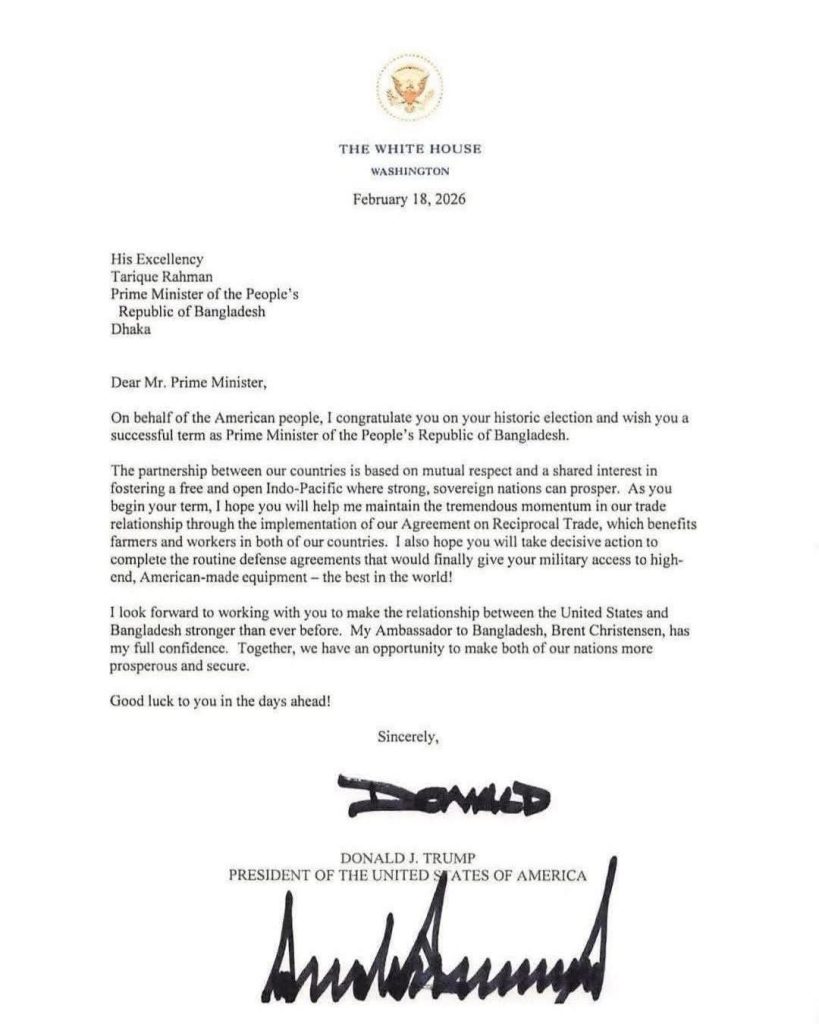
The recent congratulatory letter from US President Donald Trump to Bangladesh’s newly sworn-in Prime Minister Tarique Rahman raises serious concerns about growing American influence over the country’s sovereignty.
While the letter congratulates Rahman on his historic election victory and his assumption of office on February 17, leading the Bangladesh Nationalist Party (BNP) to a landslide win, it appears to pressure the new government into adopting policies that could further weaken Bangladesh’s independence, building directly on the controversial legacy left by the Muhammad Yunus-led interim regime.
Trump’s message emphasises sustaining “strong momentum” in US-Bangladesh trade relations, specifically urging implementation of the Agreement on Reciprocal Trade, which was hastily signed by the Yunus administration on February 9, 2026—just three days before the general election.
This deal, which reduced certain US tariffs on Bangladeshi exports from 20% to 19% while granting exemptions for some apparel using US materials (and reciprocal access for American goods), has been widely criticised by activists and analysts as economically detrimental and geopolitically risky.
Tarique’s Inaugural Address: Empty rhetoric amid unaddressed atrocities
Chaos, Capitulation, Corruption: Yunus’ 559-day jihadist nightmare
How USAID funded extremism by using radical students in Bangladesh
Critics argue it exposes Bangladesh to heavy obligations, hidden clauses, and potential long-term losses for farmers, workers, and the broader economy, while heightening tensions with China and effectively turning the country into a subservient partner—or even a de facto economic colony—of the United States.
Adding to these worries, Trump explicitly pushes for “decisive action” to finalise routine defense agreements, including access to high-end American military equipment. He highlights foundational pacts like the General Security of Military Information Agreement (GSOMIA) and the Acquisition and Cross-Servicing Agreement (ACSA), which the Awami League had firmly rejected to preserve strategic autonomy and avoid entanglement in great-power rivalries.
What did the Biden administration seek from Sheikh Hasina?

Senior journalist Probir Kumar Sarker observes that the Yunus interim period already left Bangladesh vulnerable through such rushed, opaque agreements that sidelined national interests in favour of external pressures. Now, with the BNP government—historically seen as more aligned with Western powers—taking charge under Tarique Rahman, there is legitimate fear that these divisive deals will be rubber-stamped rather than reviewed or revoked.
Yunus’ Suicidal Sellout To US: A trade deal that mortgages the nation’s future
US Tariff: West’s puppet Yunus under fire ahead of hasty, secret deal
Pro-regime Daily Star questions Yunus’ last-minute deals sans accountability
This could lock Bangladesh into a weakened, dependent position, compromising its ability to pursue an independent foreign policy, including balanced ties with China as previously attempted under the Awami League’s Indo-Pacific approach, he added.
Trump’s letter also expresses full confidence in US Ambassador Brent Christensen and eagerness to “make both nations more prosperous and secure,” but the subtext is clear: deeper integration on Washington’s terms, particularly in defense and trade, risks eroding Bangladesh’s sovereignty at a time when the country needs to rebuild strength after years of political upheaval.
Activists have demanded cancellation of the trade deal and asked the government not to sign the defense deals to avoid perpetuating the subservience engineered during the Yunus era. Failure to do so could cement a troubling pattern of foreign control masquerading as partnership.
 English
  Bengali