In the capital alone, 643 unclaimed bodies were recovered and buried over the past year—an average of two unidentified dead every single day. They were found in rivers and ponds, on streets and in canals. No names. No addresses. No families left to mourn them.
When a country begins to lose its people in this manner, the death of that country begins. Bangladesh today stands in what can only be described as a valley of death—a place where human lives vanish quietly, and the state looks away.
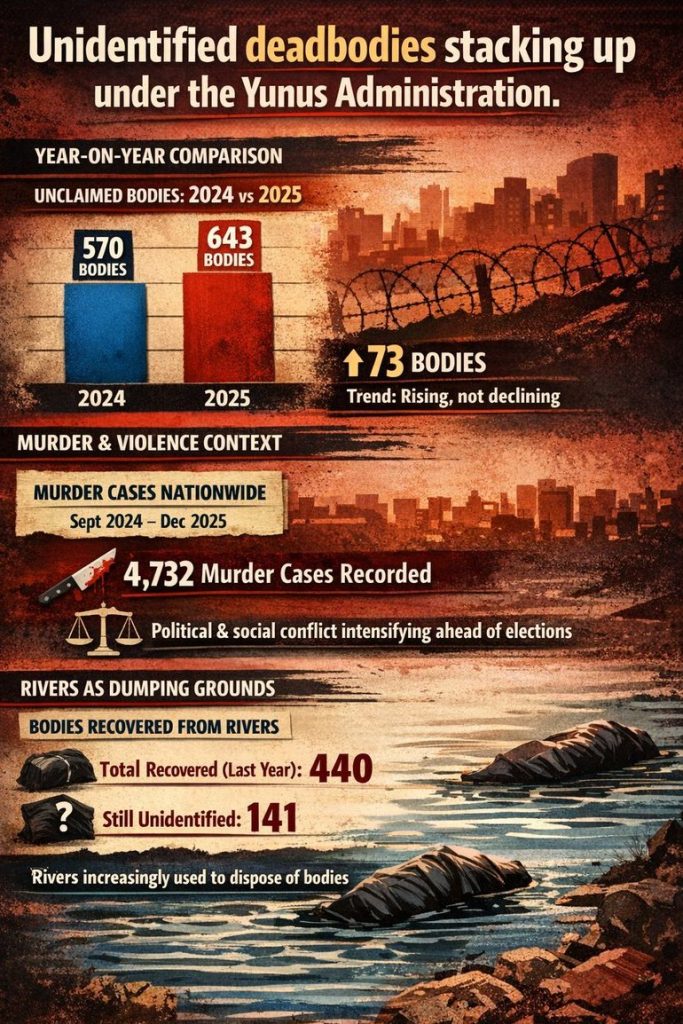
According to data from the humanitarian organisation Anjuman Mufidul Islam, 570 unclaimed bodies were buried in 2024. In 2025, that number rose to 643, an increase of 73 within a year. The rise is not merely numerical; it reflects a deepening collapse of law, order, and accountability.
Bodies Without Names, Crimes Without Consequences
Last year alone, 440 bodies were recovered from rivers in Narayanganj, one of the country’s most crime-prone districts. Of them, 141 remain unidentified. Investigators acknowledge that rivers have increasingly become dumping grounds for criminals—kill, discard the body, and disappear into the system’s silence.
Police officials cite familiar obstacles: decomposed bodies yield no fingerprints, homeless victims often lack national identity cards, and families report missing persons too late. But critics argue that these explanations no longer suffice.
How Yunus regime is coercing all to back ‘Yes’ vote in unconstitutional referendum
RAB member killed in Sitakunda armed attack amid state-sponsored mobocracy
“Is this merely investigative difficulty,” asked one human rights observer, “or the total collapse of the state’s responsibility toward its citizens?”
A Nation In Numbers—And In Freefall
Between September 2024 and December 2025, police records show 4,732 murder cases in just 16 months. On average, 2,500 cases of unnatural death are registered every month nationwide. These figures point not to isolated criminality, but to systemic breakdown.
Crime analysts link the surge to the political instability triggered by the July 2024 riots, which led to the overthrow of an elected government. The sources of those riots—foreign funding, Islamist extremist networks, and backing from sections of the military—are no longer matters of speculation, analysts say. Their consequences are now being measured in bodies.
An Unelected Authority, An Absent State
Since that upheaval, Bangladesh has been governed by an unelected authority operating under Muhammad Yunus. Critics accuse the current administration of being not only illegitimate but also functionally absent.
“There are no rules left, no principles,” said a senior journalist in Dhaka. “Everyone does as they please—and no one is held accountable.”
From July to October, the months surrounding the seizure of power, the number of unclaimed bodies spiked—70 in July, 72 in October—a period marked by violence, fear, and institutional paralysis.
Betraying Democracy: Yunus-Jamaat clique’s shameful push for rigged referendum
Yunus’ referendum is an ominous sign for Bangladesh, warns Masuda Bhatti
GCDG report highlights chaos and regime’s involvement after Hadi murder
Yet the interim authority speaks instead of reforms, economic plans, and election delays. On the issue of hundreds of unidentified dead, there has been no comprehensive investigation, no policy response, no public reckoning.
Silence At Home And Abroad
Equally striking is the silence beyond Bangladesh’s borders. International bodies that frequently invoke human rights—the United Nations, the European Union, and prominent global media outlets—have issued no urgent statements, launched no inquiries, and held no high-profile briefings on the growing trail of unclaimed deaths.
Inside the country, civil society groups and rights organisations that once mobilised quickly over injustices have remained conspicuously quiet. No major press conferences. No coordinated reports. No sustained campaigns.
HRW alarmed over violence against women, girls, and minorities in Bangladesh
US, China building military drone facilities in Bangladesh risks sovereignty
For critics, this silence is not neutral. “Silence in the face of mass, unnamed death is complicity,” said one rights activist.
Burying The Dead, Exposing The State
Anjuman Mufidul Islam continues its work—burying the dead with dignity after police clearance, charging nothing, and performing what the state has failed to do. But humanitarian action, observers stress, cannot substitute for governance.
“A state that cannot give its citizens an identity even after death,” one analyst noted, “is itself a dead state.”
Between 2010 and 2024, the organisation buried 14,876 unclaimed bodies—the population of a small town, erased without answers. Thousands of families may never know what happened to their loved ones.
Criminologist Professor Md. Sakhawat Hossain of Chittagong University has repeatedly pointed out that developed countries rely on centralised digital databases to identify victims quickly. Bangladesh lacks such an integrated system—not because it is impossible, critics argue, but because there is no political will to build one.
Unclaimed Bodies, Unclaimed Responsibility
Recent cases underscore the crisis: a body recovered from a pond in Pallabi bearing marks of violence, unidentified; another pulled from Turag Lake, half-decomposed, nameless. Each raises the same unanswered questions—who were they, who killed them, and why?
No one seems to know. Worse, no one seems eager to find out.
When human death becomes this routine, observers warn, it signals something deeper than crime—it marks the erosion of humanity itself.
Bangladesh today is facing that reckoning: a country where lives end without records, where power is held without mandate, and where silence—domestic and international—has replaced outrage.
A country where people die, and no one feels compelled to ask why.
By: albd
 Bengali
  English