Indian security agencies are piecing together a disturbing web of jihadist networks linking Bangladesh’s interim government under Muhammad Yunus to the deadly Red Fort car blast on November 10, which claimed 13 lives.
Despite vehement denials from Dhaka, evidence points to coordinated planning involving Pakistani terror outfits and Bangladeshi operatives, building on a history of escalating threats from Islamist groups like Jamaat-e-Islami (JeI), the National Citizen Party (NCP), and affiliated militants in recent weeks.
This attack is not an isolated incident but part of a pattern of anti-India aggression that has intensified since the ouster of former Prime Minister Sheikh Hasina in August 2024. JeI, a banned Islamist outfit with deep roots in radical ideology, has long viewed India as an existential enemy, funding terror activities and inciting violence across the border.
In 2006, JeI reportedly channeled $100,000 to jihadist cells in India, supporting attacks in Jammu and Kashmir. More recently, following Hasina’s fall, JeI leaders have amplified anti-India rhetoric, framing Hindu minorities in Bangladesh—perceived as pro-India—as targets for “extermination” via social media threats.
In September 2025, JeI leader Syed Morshed Ali Alvi Taher openly warned of a “jihad against India” during a New York event, vowing retaliation for perceived Indian interference in Bangladesh’s affairs. The lifting of JeI’s ban in September 2024 has further emboldened the group, signalling official tolerance for its violent agenda.
Sheikh Hasina condemns Delhi car blast, says Pakistan is root of terrorism
Press Club of India slams Yunus’ press secretary, demands apology
Extremism: India, Myanmar, Nepal should be cautious about Bangladesh
Compounding these concerns, NCP leaders—emerging from the student-led protests that toppled Hasina—have echoed Islamist hardliners in portraying India as a destabilizing force. In May 2025, NCP chief organizer Sargis Alam issued threats against pro-liberation parties, accusing exiled Awami League figures in India of plotting against Bangladesh’s security and calling for heightened border vigilance amid India-Pakistan tensions.
The NCP has sought to unify Islamist factions, including JeI sympathizers, in rallies that blend anti-India sentiments with demands for Sharia law, fueling a surge in extremist content online. Militant proxies like the Al-Qaeda-linked Harkat-ul-Jihad-al-Islami-Bangladesh (HuJI-B) have also revived operations, with propaganda in June 2025 exploiting a Pahalgam terror attack in India to justify cross-border jihad and anti-Hindu pogroms. Groups such as Jama’atul Mujahideen Bangladesh (JMB) and Ansarullah Bangla Team (ABT) have historically plotted attacks on Indian soil, including foiled New Year bombings, underscoring Bangladesh’s growing role as a jihadist launchpad.
Bangladesh’s interim foreign adviser, Md. Touhid Hossain, dismissed Indian media reports as baseless, insisting that “Bangladesh’s soil is not being used for activities against India.” Yet, agencies tracing the blast’s origins have uncovered irrefutable ties to a high-level meeting in Dhaka, orchestrated by Pakistan’s Lashkar-e-Tayyiba (LeT) just weeks before the explosion.
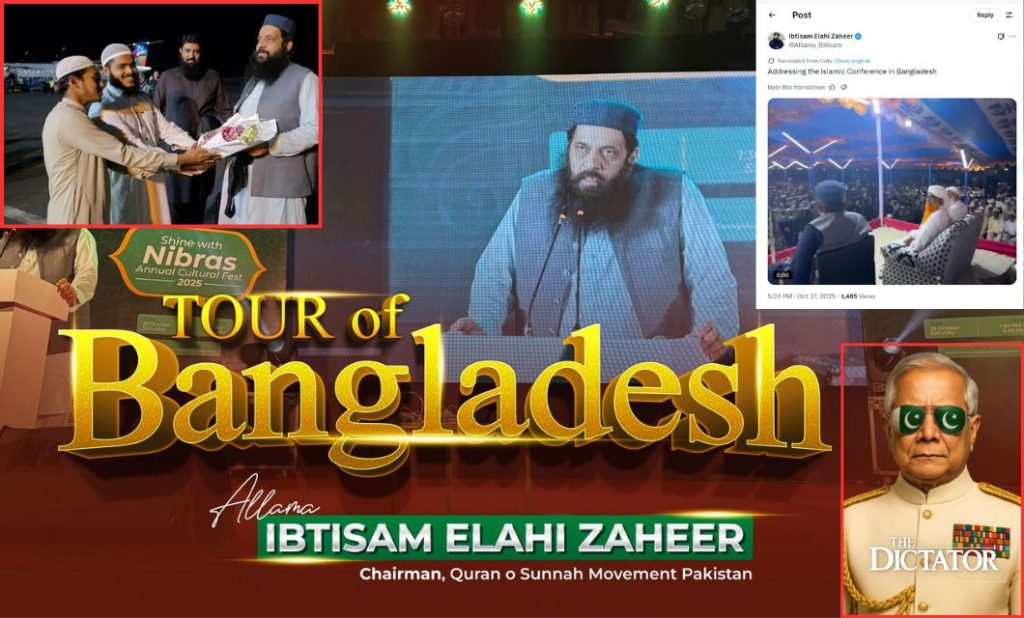
The probe has zeroed in on a virtual conclave in late October in Dhaka’s upscale Banani neighbourhood, where LeT commander Saifullah Saif—Hafiz Saeed’s key deputy—issued directives for major strikes in India. Saif joined remotely from Pakistan, while seven attendees gathered in person: Dhaka chief of the banned Hizb-ut-Tahrir (HuT), Zubair Ahmad Chaudhury; Saif’s aide and Markazi Jamiat-Ahl-e-Hadith secretary Ibtisam Elahi Zaheer; interim regime’s home affairs secretary Dr. Nasirul Ghani; Dhaka North City Corporation CEO and HuT coordinator Mohammad Azaz; ABT up-pradhans Hafiz Shujadullah and Hafiz Ali Fazul; and explosives specialist Sumon Ahmed.
Why has Rajnath Singh asked Yunus to watch his words?
Disappearance Drama: Once used against Awami League, now against Hindus
USS Fitzgerald in Bangladesh: Goodwill or geopolitical gambit?
Sources reveal Saif outlined attack logistics, promising LeT support from Pakistan, including material supplies. Alarmingly, serving officials Ghani and Azaz participated, discussing seamless coordination. Post-meeting, a cell led by the explosives expert infiltrated India via Murshidabad in early November, tasked with training sleeper cells in West Bengal and beyond for synchronized assaults.
In Murshidabad, the group allegedly holed up at a safe house owned by fugitive Bangladeshi Iqtiyar, wanted for murdering a detective branch officer. Long a hub for ABT operatives, the site has facilitated cross-border logistics. While Iqtiyar’s involvement appears logistical so far, investigators are probing deeper links to the blast’s ammonium nitrate-based device.
Preliminary findings also indicate Pakistani-sourced explosives and detonators reached West Bengal, funneled through Bangladesh routes. Multi-agency teams, including the National Investigation Agency (NIA) and National Security Guard (NSG), have fanned out to Murshidabad, launching a manhunt for border-crossers from Bangladesh’s Rajshahi district.
The timing raises red flags: Just 10 days prior, on October 30, Saif rallied supporters in Pakistan’s Khairpur Tamiwali, boasting, “Hafiz Saeed is not sitting idle. His right hand (Zaheer) is in Bangladesh, preparing to attack India through Bangladesh. Lashkar operatives are active in East Pakistan (Bangladesh) and ready to answer India for Operation Sindoor… Now, America is with us, and Bangladesh, snatched from us, is closer to Pakistan again.”
Saturday’s detentions of three suspects—including two Al Falah University doctors from Haryana—have broadened the net. Two FIRs against the university cite UGC and NAAC-flagged irregularities, amid scrutiny of its ties to radical networks. This comes as probes escalate into the blast and university-linked extremism.
Bangladesh’s unrest since August 2024 has amplified these threats, with JeI and NCP-fueled protests morphing into anti-India campaigns, radicalising youth, and providing cover for militants like ABT and HuJI-B. Indian agencies warn of a “dangerous turn” in Dhaka, potentially turning Bangladesh into a radical haven. As the investigation deepens, New Delhi braces for further incursions, urging Dhaka to dismantle these networks before they ignite a regional firestorm.
 Bengali
  English