The claim by Chief Adviser Dr Muhammad Yunus and his Press Secretary Shafiqul Alam that Bangladesh’s media enjoys unprecedented freedom is a stark contradiction to the reality faced by journalists since the interim government took power in August 2024.
Shafiqul Alam’s remarks at the Center for Governance Studies seminar on June 26, labeling mobs as “pressure groups” and blaming journalists for eroded public trust, dismiss a grim truth: over 260 journalists face murder charges, many are imprisoned without trial, media offices are occupied, accreditations are revoked, and the government’s press wing exerts pressure to censor critical content.
Reports from Article 19 and Human Rights Watch (HRW) further expose this repression, highlighting a systematic assault on press freedom that undermines the interim government’s narrative.
Journalist Masood Kamal: Yunus is dividing the nation, provoking civil war
July fraud busted: Saifuddin claims was shot in two cities the same day
Holey Artisan Carnage: Why is Yunus patronising Islamic State jihadists?
How the deep state engineered Sheikh Hasina’s ouster in August 2024
Since August 2024, Bangladesh’s media landscape has deteriorated alarmingly. Article 19’s October 2024 statement notes that the interim government has failed to protect freedom of expression, with over 296 journalists charged, 600 cases filed, 18 arrested, 1,000 fired or forced to resign, 168 accreditations cancelled, and 83 press club memberships revoked.
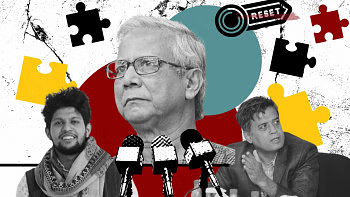
These actions, coupled with physical attacks and vandalism of media outlets, create an environment of fear and censorship. HRW’s 2023 report, while addressing the previous Awami League government, underscores a longstanding pattern of crackdowns on journalists, a trend that persists under Yunus.
The revocation of accreditation cards and occupation of media offices signal a continuation of state-driven intimidation, not a break from it.
Shafiqul Alam’s assertion that Bangladeshi journalism is freer than in developed nations is not only baseless but dangerous. He blames journalists for public distrust, citing alleged calls for violence by “top journalists” under the prior regime and decrying “lazy journalism” on social media.
Revoking journalists’ accreditation cards was a mistake, says CA press secy
Yet, as Article 19 points out, the interim government’s actions—such as pressuring media to edit or remove critical stories—directly contribute to this distrust by stifling legitimate reporting.
The shift to social media as a news source, which Shafiqul Alam criticises, is a consequence of traditional media being silenced through arrests, firings, and office occupations. Rather than addressing these root causes, Shafiqul Alam deflects blame, framing journalists as the problem while sanitising mob violence as “pressure groups.”
The interim government’s failure to uphold press freedom is further evidenced by its inaction on legal protections for journalists. Article 19 calls for the repeal of repressive laws and the establishment of an independent commission to investigate attacks on journalists—recommendations ignored by Yunus’ administration.
Shafiqul Alam’s proposal for a Journalist Protection Ordinance rings hollow when he simultaneously demands protection for those “harmed” by misreporting. This false equivalence equates the systemic persecution of journalists with the reputational concerns of government officials, ignoring the power imbalance.
As HRW notes, criminal defamation laws and vague charges like “anti-state activities” are weaponised to silence dissent, a tactic that persists today with murder cases filed against journalists.
Shafiqul Alam’s rhetoric reveals a troubling prioritisation of shielding the powerful over protecting the press.
His complaint that government officials lack protection from media scrutiny—contrasted with Western models where fines address misinformation—ignores the absence of robust legal frameworks in Bangladesh to safeguard journalists. In the UK, fines for libel coexist with strong press protections; in Bangladesh, journalists face imprisonment without trial.
The occupation of media offices and pressure from the government’s press wing, led by Shafiqul Alam, further eroded any claim to media freedom.
For Bangladesh to achieve true press freedom, the interim government must act decisively: drop baseless charges, restore accreditations, end media office occupations, and engage with stakeholders to enact protective laws.
Yunus, a Nobel Peace laureate, carries the weight of international expectations to uphold democratic values. Yet, his administration’s actions betray this legacy. The facade of media freedom, propped up by Shafiqul Alam’s dismissive rhetoric, cannot mask the reality of persecution. Until the government addresses these systemic abuses, as urged by Article 19 and HRW, Bangladesh’s journalists will remain under siege, and the promise of a free press will remain an illusion.
 Bengali
  English