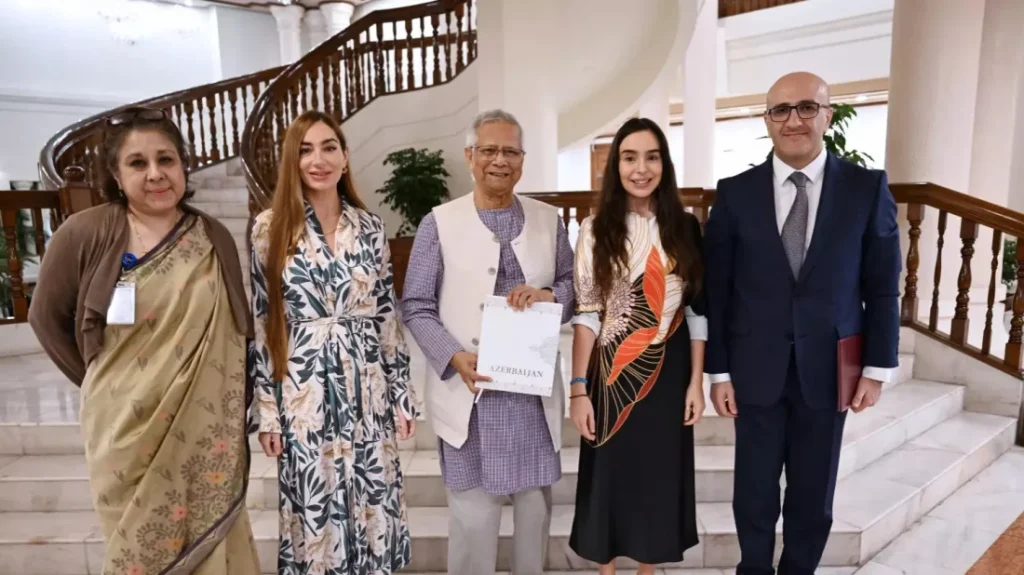
In a meeting that has ignited a firestorm of controversy, Chief Adviser Professor Muhammad Yunus hosted the daughters of Azerbaijani President Ilham Aliyev at the State Guest House Jamuna on Sunday. The visit, framed as a push for stronger trade, energy, and cultural ties, is now under intense scrutiny following explosive revelations by security expert Aminul Hoque Polash, who alleges it conceals a plot to launder billions from Yunus’ telecom empire through the Aliyev family’s notorious offshore networks.

Newly surfaced visual evidence, including screenshots from global investigations like the Pandora Papers, visually links the exact individuals involved to a web of corruption spanning London real estate and hidden telecom fortunes.
The encounter between Yunus and Leyla and Arzu Aliyeva—the president’s daughters, whose faces grace exposés on money-laundering scandals—comes amid negligible diplomatic ties: Azerbaijan has no embassy in Dhaka, and bilateral trade is minimal.
Yet, according to Polash, a former National Security Intelligence (NSI) officer and exiled political researcher, this is no coincidence. “This is not a diplomatic courtesy; it’s a calculated move to siphon off Yunus’ ill-gotten gains before he exits power,” Polash declared in an exclusive revelation shared on social media and corroborated by declassified documents and international leaks. “We are watching you, Yunus!”
A Facade of Friendship, Exposed by Leaked Files
On the surface, the meeting appeared benign. Yunus, the Nobel laureate and architect of microfinance, reminisced about his visits to Baku and a prior encounter with President Aliyev at the COP29 summit in November 2024. Leyla Aliyeva, vice president of the Heydar Aliyev Foundation and head of the IDEA Public Union, extended her father’s greetings and pitched joint ventures in environmental conservation, wildlife protection, and humanitarian aid for orphans—a nod to the sisters’ recent visit to a Dhaka orphanage.
From NGO Activist to Power-Broker: The Meteoric Rise of Dr. Nabila Idris
The Sunday Guardian: Yunus turned public benevolence into private dominion
Yunus’ Floor Space Scandal: Ex-NSI officer exposes Nobel laureate’s corruption
Arzu Aliyeva echoed calls for youth, volunteer, and nature-protection projects, while Non-Resident Ambassador Elchin Huseynli announced plans to establish an Azerbaijani embassy post-elections, fulfilling Yunus’ November request to elevate bilateral relations. SDGs Affairs Principal Coordinator Lamiya Morshed was also present, underscoring the emphasis on sustainable development goals.
But beneath the platitudes, Polash contends, lurks a web of corruption mirroring the Aliyev family’s infamous offshore empire. President Aliyev, who has ruled Azerbaijan since 2003 in an autocratic petro-state, has long faced accusations of looting national resources through family-controlled entities. Investigative leaks like the Panama Papers and Pandora Papers exposed how the Aliyevs amassed hidden wealth via shell companies in Panama, the British Virgin Islands, and Malta, funnelling billions into London real estate, Dubai mansions, and gold mines.
Leyla and Arzu, in particular, have been central figures—and the very same women photographed arm-in-arm with Yunus in Dhaka. Screenshots from The Guardian and OCCRP’s Pandora Papers investigation show them prominently featured in headlines like “Azerbaijan’s Ruling Aliyev Family and Their Associates Acquired Dozens of Prime London Properties Worth Nearly $700 Million.”
The leaks detail how the sisters, along with their brother Heydar (who owned a £33 million Mayfair office block at age 11), used 84 interconnected offshore companies administered by Trident Trust to secretly snap up luxurious penthouses, commercial spaces, and even an old tavern in London’s heart. Between 2006 and 2017, the family and associates traded nearly £400 million in UK properties, often flipping them for massive profits – including a £67 million sale to the UK’s Crown Estate in 2018, prompting an internal review over potential money-laundering red flags.
The sisters’ Azercell connection is equally damning. Visuals from OCCRP and Wikipedia entries confirm Leyla and Arzu secretly control 72% of Azerfon (branded as Azercell), Azerbaijan’s largest mobile operator, through three Panamanian offshore firms granted suspiciously during their father’s regime in 2005. Profits are routinely diverted to offshore accounts, funding a “vast empire” in the UK and UAE.
Taslima Begum: From Nobel spotlight to a shabby hut as Yunus grabs it all
Exclusive: Ex-NSI officer proves how Yunus hijacked microcredit idea
Nobel for Yunus meant for gaining control of Chittagong Port, Bay of Bengal
A 2018 UK tribunal fined London law firm Child & Child £45,000 after senior partner Khalid Sharif admitted failing to conduct proper anti-money-laundering checks on a £60 million property deal brokered for the sisters—the first such penalty tied to the Panama Papers. The tribunal flagged the transaction as carrying a “significant risk of money laundering.”
“The Aliyev daughters have built worldwide notoriety through corruption, offshore companies, and money laundering,” Polash wrote in Bengali, referencing their Panama Papers entanglements. “Their visit to Yunus is no accident. With no embassy or major economic ties in Bangladesh, why now? These are the exact faces from global anti-corruption dossiers.”
Yunus’ Mirror Image: Grameenphone’s Shadowy Billions
Polash’s bombshell draws a damning parallel to Yunus’ own empire. Grameen Telecom (GTC), founded with funds from Grameen Bank—the microfinance institution Yunus built on public and donor benevolence—holds a 34.2% stake in Grameenphone (GP), Bangladesh’s top telecom giant. GP, a Telenor joint venture, boasts a market capitalisation of approximately Tk376 billion (around $3.2 billion) as of late November 2025, with shares trading at Tk278.40.
GTC’s share is valued at over Tk128 billion (about $1.1 billion), Polash calculates. Add cumulative dividends—nearly Tk15,000 crore (Tk150 billion, or $1.25 billion) by 2025—plus reinvestments, and GTC’s total assets balloon to around Tk30,000 crore ($2.5 billion) under Yunus’ singular control. Yet, Yunus has faced repeated scandals over these funds. Workers sued him in 2023 for allegedly misappropriating Tk25 crore in dividends meant for employee welfare funds, violating labour laws.
A 2025 labour court settlement of Tk437 crore highlighted “systemic” non-compliance, with critics accusing Yunus of diverting profits from the rural poor to personal dominion.
The Great Plunder in MP Project: Corruption and deception under Yunus
Dr. Yunus: A portrait of self-interest and deception
Corruption, suspension of operation plans cripple Bangladesh health sector
Yunus’ defenders, including his office, insist he receives no personal dividends, as GTC is a non-profit under Bangladesh’s Companies Act. But Polash, drawing from his NSI tenure, claims otherwise: “Grameen Telecom was built with Grameen Bank’s money for borrowers’ welfare. Prime Minister Sheikh Hasina granted the GP license in 1997 to channel dividends back to the poor. Yunus seized sole control, turning public benevolence into a Tk30,000 crore slush fund.”
A Pre-Power-Exit Heist, Echoing Azercell’s Playbook
Polash’s core revelation: The Aliyeva sisters were “summoned” to advise on laundering GTC’s fortune abroad. “They’re experts in this line—controlling Azercell, siphoning dividends offshore, building empires in the UK,” he wrote. Rumours swirl of plans to sell GTC, with the Aliyev daughters brokering the deal to expatriate assets before Yunus relinquishes power. “Before leaving office, he’ll arrange to smuggle this wealth out,” Polash warned.
This echoes the Aliyevs’ playbook: using telecom profits to fund opaque foundations like Heydar Aliyev’s, which Polash likens to Yunus’ “social business” facade. The Sentry’s 2024 “Aliyev Empire” investigation mapped $180 million flowing through Malta, Dubai, and Abu Dhabi for property grabs, flagging a $73 million Moscow deal as suspicious.
Screenshots from Turkish media and Global Voices further illustrate the sisters’ hidden stakes in Azercell via layered offshore trails, allowing government control of nearly three-quarters of Azerbaijan’s mobile market. “Yunus is following the script,” Polash added.
The meeting has ignited fury in Bangladesh’s polarised politics. Exiled after probing Yunus’ alleged graft during his NSI days, Polash—now a vocal activist—positions his exposé as a “watchdog” alert. Supporters decry it as smear tactics amid Yunus’s interim role since August 2024, post-Sheikh Hasina’s ouster. Yunus’s team has dismissed similar claims, citing dropped 2025 cases as vindication.
Yet, as Bangladesh eyes elections, the optics are toxic. With no major Azerbaijan-Bangladesh trade (beyond vague energy talks), critics ask: Is this diplomacy or a corrupt alliance? The visual match—Yunus beaming alongside the Pandora Papers’ poster children for kleptocracy—has turned whispers into a roar. As one Dhaka-based analyst put it off-record today: “If this isn’t the tutorial session on ‘How to Move a Billion Dollars Offshore 101,’ I don’t know what is.”
Polash’s closing shot: “One thing is clear: Grameen Telecom’s money belongs to the poor, not offshore vaults. We’re watching!”
As investigations loom, Yunus’ “banker to the poor” legacy hangs in the balance – tainted, perhaps, by the very wealth it sought to uplift.
 English
  Bengali