This Irish proverb—Tirgan teanga, tirgan anam—means a country without a language is a country without a soul. So does the Indonesian—Bahasa jiwa bangsa (language is the soul of a nation). We do not know how far the Irish or Indonesian people could understand the spirit of those sayings, but we know for sure that the people of Bangladesh could very well understand the nation-language connection and did their best about it. They could realise the importance of language in the building up of a nation and were able to find their nation on a firm linguistic and cultural footing that has put their country on the map, thanks to the dynamic leadership of Bangabandhu Sheikh Mujibur Rahman.
Bangladesh is a state that was founded on the basis of Bengali nationalism, whose soul is the Bengali language. It is the quintessence of what we call a nation-state, and the core of this nationality is deeply rooted in the language. When the language felt insecure, and its existence was threatened with extinction in a country ruled by alien masters, it demanded self-rule. The demand extended.
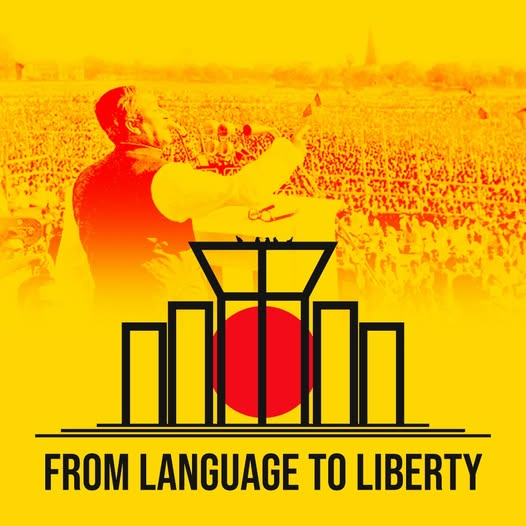
The birth of Bangladesh became inevitable when the Bengali language aspired to a state of its own. So, the history of the emergence of Bangladesh is the history of a long and rugged way from autonomy to independence. And the seeds of that autonomy were sown in the hearts and minds of the Bengali folks, primarily on the question of language. They felt, for the first time, the urgency of home rule when their mother tongue fell victim to an unprovoked attack by the Pakistani rulers right after the partition of India in 1947.
The so-called “two-nation theory” had already started to backfire. The people of East Bengal realised that they would need to make amends for the historical blunder of the Indian subcontinent committed by Gandhi, opportunist Jinnah, egoistic and shrewd Nehru, and the crafty British Raj. This crude awakening led the East Bengal folks to the road to autonomy and then to independence.
Language Movement: Not five, but dozens were killed on February 21-22
Language Movement: Story of the first Shaheed Minar at medical barracks
Really, it was one of the costliest mistakes in human history to divide a country merely on the grounds of religious affiliation, where people, regardless of castes, creeds, and religions, had been united under an anti-British umbrella. Post-partition India could have been one of the world’s biggest lands with a wide variety of people and cultures, with a great wealth of talent. There would have been greater diversity and choice in socio-economic and political life, which is called “unity in diversity.” The cultivation of this kind of holistic approach to religion would have played a highly instrumental role in the moribund subcontinent, where religious extremism rules the roost and mutual respect has been held hostage by religious fundamentalism and militancy. But the vested quarters had separated one from the other by a preposterous religio-political surgery, which has perpetuated ethnic disharmony in the subcontinent.
As a matter of fact, the “two-nation theory” proved abortive almost immediately. The true character of the self-styled guardians of Islam was unmasked. The West Pakistani rulers assumed a big brotherly and holier-than-thou attitude towards the East Pakistanis. They unleashed the big stick upon them. Other than the sameness of religious identity, no other affinities could develop between the West and the East Pakistanis. In addition, the neo-champions of Islam thought a language like Bengali, which originated from and developed through “non-Islamic” sources and influences, was not worthy of being the official language of a newly emerged “holy place,” Pakistan (Pak—holy and Stan—place). They also thought that, having been a part of the “holy place,” the then Indian province of “East Bengal” needed to be renamed and considerably sanctified. They named it “East Pakistan” and tried to make Urdu its official language.
Although Urdu is an Indian language and a standardised form of Hindi, it is written in the Arabic script and used by Indian and Pakistani Muslims. So, they consider it holier than Bengali, which originated from a dialect of India and was nurtured by Buddhist and Hindu monks over the centuries. This was at the back of the mind of those Pakistani neo-custodians of Islam. So, they planned to make Urdu the official language of Pakistan and did not give a damn about Bengali, although Bengali was used by the majority of the people in Pakistan.
Jamaat chief goes to Shaheed Minar with war criminal Azhar, faces backlash
Jamaat’s 77 seats signal continuation of militancy, mob violence under BNP rule
But all their efforts came badly unstuck. The Bengali language is the lifeblood of the Bengali people. They prefer death to dishonour of their mother tongue. They are happy with their own sweet language. They have won the Nobel Prize for their literature in that language. This is their proud possession. They do not bother about whether or not their language is “sacred.” When Jinnah, the Governor General of Pakistan, made the declaration at Dhaka University Curzon Hall that Urdu and only Urdu would be the official language of Pakistan, the agitated audience threw a straight “no” at him. Even then, the rulers did not see sense and abandoned the unworkable policy.
The people of East Bengal came to realise that their language and literature, society and culture, politics and economy—all of their life and legacy—are not in safe hands. They discovered that the Pakistani rulers, under the guise of religious fraternity, are in truth snakes in the grass. It was a no-go asking them for the rights to the language. So, they put up the line of active resistance. Strong leadership was there to captain the people, and that was the leadership of Bangabandhu Sheikh Mujibur Rahman, the paramount leader. The Pakistani government tried to subdue the popular uprising with iron hands. This fanned the flame of the fight. There came the 21st of February (1952). Innocent blood was spilt in the line of resistance. But there is no holding the Bengali. They had learned to die for their mother tongue. The public defiance gained momentum. Martial law was let loose to put a curb on the popular movement. But all repressive government measures produced diminishing returns.
Sajeeb Wazed: Yunus administration is propped up by Jamaat
Why does Jamaat-patron US want a weak government in Bangladesh?
Jamaat’s Shadow Empire: Diplomatic charms abroad, authoritarian grip at home
People came up with the historic “Six-Points” (1966), which amounted to full autonomy for East Bengal. The autonomy movement became so intense that the ruling government was compelled to hold a general election (1970). The Bengali won a landslide victory. But the rulers were not willing to give in so easily. They shot their last bolt. Operation Searchlight (March 25, 1971) was launched. The Bengalis were at the point of no return. They already had their back to the wall. So, they decided to fight it out. And they fought to a finish and seized their most prized possession, their independence, in exchange for a sea of blood.
If our national liberty (1971) compares with the fruit of a tree, the trunk of the tree is the 24-year struggle for autonomy, and the root is the language movement (1952). The history of Bangladesh is the history of the whole tree, from the root to the fruit. If we want to enjoy the fruit of our liberty, we have to take care of the whole tree and the ground it is planted in. As the Rig Veda puts it: “One should respect his motherland, his country, and his mother tongue because these are givers of happiness.” We can never be happy in the true sense of the term without loving this national trinity—Bangladesh, Bengali culture, and the Bengali language.
 English
  Bengali