In a bold act of defiance against years of administrative neglect and what students describe as deliberate obstruction, Hindu students at Jagannath University in Dhaka have successfully installed photos of deities to occupy the land for a central temple on campus for over 2,500 Sanatan followers, thwarting plans to convert the proposed site into a public toilet.
The move, which culminated in a ceremonial inauguration on February 3, highlights the ongoing struggles of religious minorities in Bangladesh amid accusations of systematic persecution under the Jamaat-controlled interim government led by Hindu-hater Nobel laureate Dr. Muhammad Yunus, who thinks that Hindus are targeted for supporting the secularist Awami League.
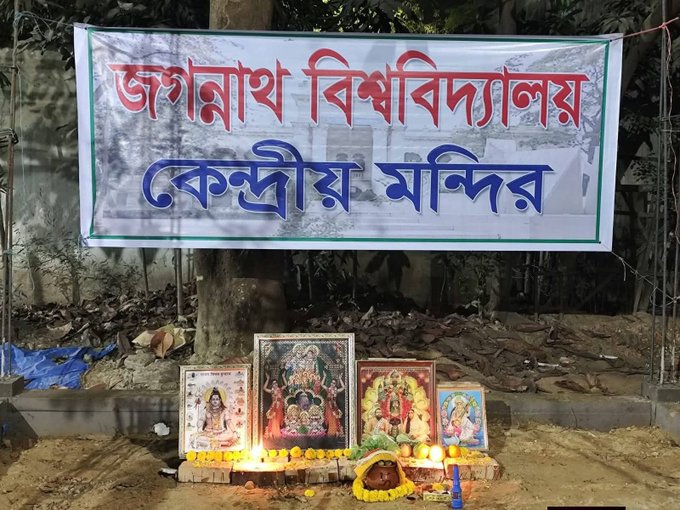
The event comes just days before national elections, including a referendum on constitutional reforms that critics fear could further erode secularism and minority rights. Minority leaders have warned that such incidents are symptomatic of a broader environment of intimidation and violence, potentially suppressing voter turnout among Hindus, Buddhists, Christians, and indigenous communities.
Years Of Demands Met With Inaction
For nearly a decade, Hindu students at Jagannath University—originally founded as Jagannath College in the early 20th century with funding from Hindu zamindar Kishori Lal Roy Chowdhury—have campaigned for a central temple to serve the spiritual needs of approximately 2,700 Hindu followers on campus. Despite repeated memorandums, discussions, and peaceful protests since 2016, the university administration failed to act, leaving students feeling marginalised.
On February 3, frustrated by the lack of progress, students took matters into their own hands. They organised a sit-in protest at the university’s open stage around noon, chanting slogans. By evening, in the presence of fellow Hindu students, they conducted the temple’s formal inauguration and performed a bhumi puja (ground worship) according to religious rites.
Report: 66 minority deaths, 28 rapes, 95 temple attacks occurred in 2025
Jihadist backing, minority persecution are foundations of Yunus’ power
Yunus’ Hate Campaign: Another Hindu youth burned alive in Narsingdi
Ajay Pal, general secretary of the Sri Chaitanya Education and Culture Association, recounted the frustration: “We have submitted memorandums to the administration multiple times. The vice-chancellor told us there was a space shortage. We even identified a spot next to the open stage ourselves. But sadly, that place is now being earmarked for a public toilet. This is an extreme disregard for our religious sentiments.”
Priyanto Swarnakar, acting president of the Student Unity Council, added: “Without informing us, the decision was made to build a toilet on the land designated for the temple. This is not just an administrative decision; it’s an attack on our religious feelings.”
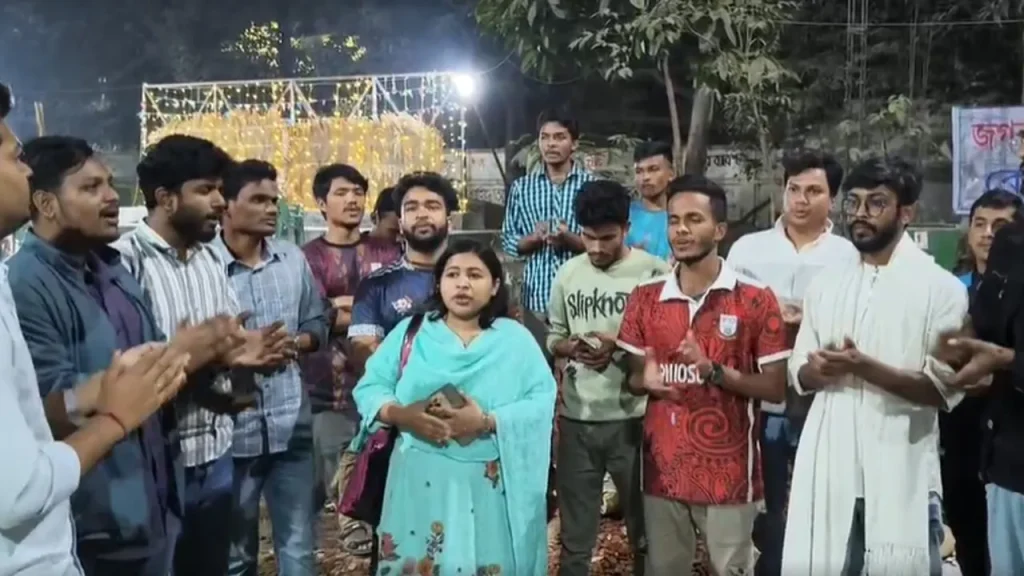
Suman Kumar Das, president of the Jagannath University Sanatan Student Council, emphasised their resolve: “We had already announced that we would perform the foundation puja at the designated site today. Due to the administration’s inactivity, we were forced to start the central temple installation ourselves.”
Hindus protest in Dhaka, London, demanding sanctions on Yunus regime
Feni Jubo Dal activists suspected for murder of Hindu youth over extortion
Oikya Parishad demands BNP scrap Harun’s candidacy for anti-Hindu rhetoric
Students expressed hope that the temple would not only serve as a place of worship but also as a centre for religious and cultural activities, urging the administration to recognise and support it.
Solidarity From Activists, Political Groups
The protest drew support from various quarters, including the university’s branch of Chhatra Dal, the student wing of the Bangladesh Nationalist Party (BNP). Leaders joined the sit-in, voicing solidarity and calling for equal religious facilities on campus.
Md. Shahriar Hossain, joint convener of the branch Chhatra Dal, stated: “In our non-communal Bangladesh, everyone should live together harmoniously as students. All students have the right to practice their religion. We’ve heard there are over 2,500 Sanatan students here, and their demand for a temple to practice their faith is longstanding. We want the administration to take their demand seriously and implement appropriate measures.”
Ankan Karmakar, a participating Hindu student, noted: “Most legitimate demands of Jagannath University students have been achieved through movements. The demand for a central temple is not new. This is not just the demand of Sanatan students, but a legitimate demand of all the students.”
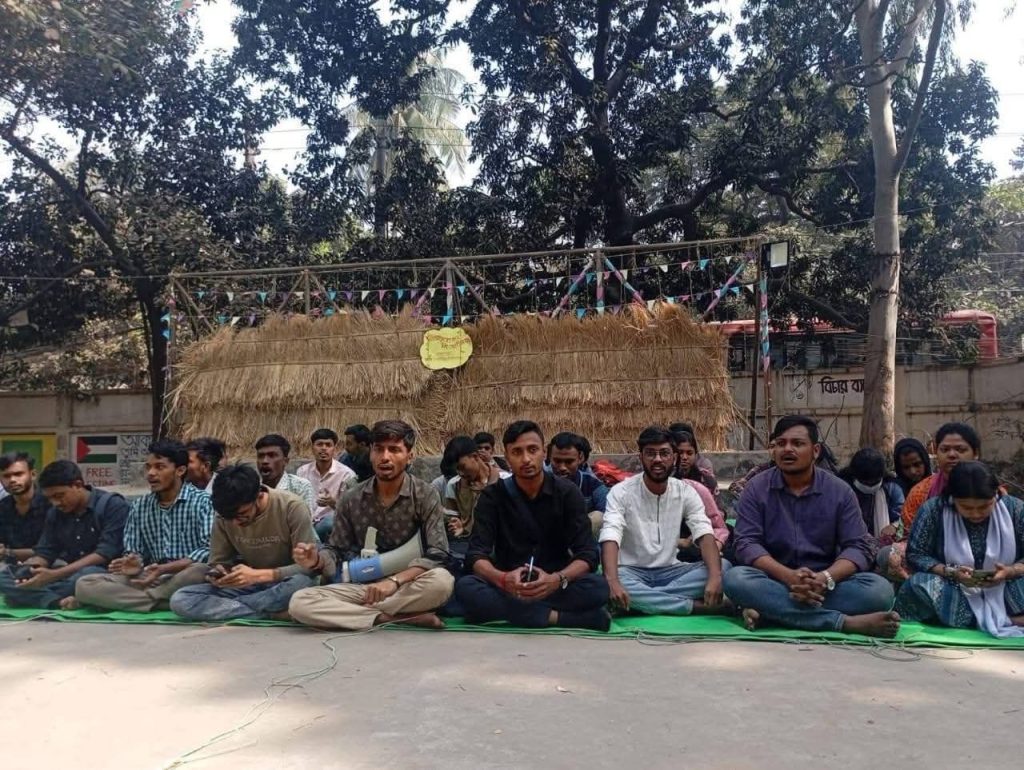
Mehedi Hasan Himel, convener of the branch Chhatra Dal, highlighted equality: “At Jagannath University, Hindu-Muslim students all pay the same admission fees. So why should any student be deprived of religious facilities? Bangladesh is a non-communal state—there should be no division between majority and minority.”
Hindu Lynching: High Court slams Yunus regime with demand for massive compensation
Touhidi Janata destroys Hindu village in Rangpur over blasphemy allegations
Lashkar-e-Tayyiba militants arrive in Dhaka as Yunus resumes Karachi flights
Dr. Kushal Baran Chakraborty, in a public statement, condemned the administration’s toilet plan as “extremely regrettable and concerning,” urging support for the students’ “justifiable demand.” He noted that despite multiple memorandums, no positive response came, leading to the self-initiated action.
While other religious groups on campus have access to worship facilities, Hindu students have long been denied similar accommodations, fueling claims of discrimination.
Yunus’ Systematic Persecution
The temple installation has been framed by critics as a direct challenge to policies under Dr. Yunus’ interim government, which assumed power in August 2024 following political upheaval. The headline-grabbing “public toilet project” is seen as emblematic of broader efforts to marginalise minorities, with Yunus accused of aligning with Islamist groups like Jamaat-e-Islami. This alliance, detractors claim, has created an atmosphere where anti-minority violence flourishes with impunity.
The Bangladesh Hindu Bouddha Christian Oikya Parishad (BHBCOP) recently documented 522 communal incidents against minorities in 2025 alone, including 66 murders, 28 cases of sexual violence, 95 attacks on places of worship, and 102 assaults on homes and businesses. Violence has continued into 2026, with 42 incidents by late January, including 11 murders and 9 temple attacks.
Monindra Kumar Nath, acting general secretary of BHBCOP, during a January 29 press conference, decried the “systemic persecution” and “denial by authorities,” attributing it to jihadist influences backing Yunus. He highlighted cases like the beheading of van driver Sukumar in Natore, the burning alive of Dipu Chandra Das in Mymensingh over false blasphemy charges, and the arson of Hindu homes in Chittagong and Pirojpur.
Saraswati idol desecrated in Gopalganj amid wave of anti-Hindu violence
Jamaat leaders’ cow feast near sacred Chandranath Temple sparks outrage
Islamists building a mosque near Chandranath Temple 90% confirmed
Other grim examples include the lynching of Amrit Mandal in Rajbari, the throat-slitting of freedom fighter Yogesh Chandra Roy and his wife in Rangpur, and the murder of gold trader Prantosh Sarkar in Narsingdi. These acts, often mob-driven, have led to mass displacement, with minorities fleeing for safety and disrupting education, business, and family life.
Critics point to Yunus’ administration as fostering this “culture of impunity,” with headlines like “Yunus’ Hate Campaign: Another Hindu youth burned alive in Narsingdi” and global protests in Dhaka and London demanding sanctions on the regime. The university’s toilet plan, students argue, is a microcosm of this erasure—replacing a sacred space with a utilitarian one, symbolising the devaluation of Hindu heritage in an institution founded by a Hindu philanthropist.
Students have called on the administration and government to ensure protection and recognition for the new temple, emphasising that in a truly non-communal nation, all faiths deserve equal space to thrive.
 English
  Bengali