Key members of the US House Committee on Foreign Affairs expressed deep concern over Bangladesh’s interim government’s decision to fully suspend the activities of the Awami League, the country’s largest and historically dominant political party, in a strongly worded bipartisan letter.
The letter, addressed to Chief Adviser Dr. Muhammad Yunus, warns that such measures could undermine the credibility of upcoming national elections scheduled for February 2026 and perpetuate a “cycle of retaliation” rather than foster a genuine democratic transition.
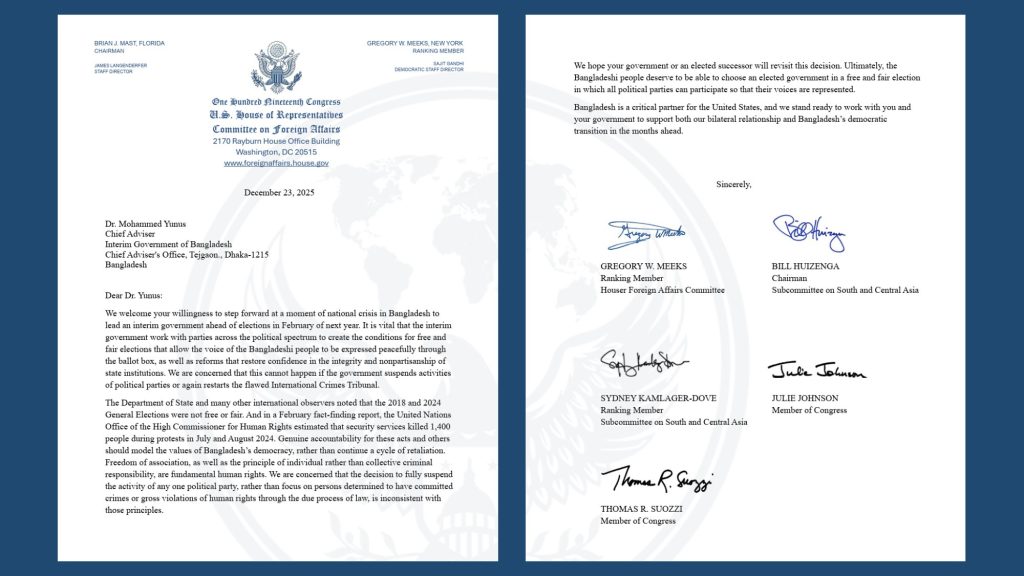
The call highlights the critical importance of inclusivity to restore public confidence in state institutions and ensure a peaceful, representative democratic future.
The signatories include Chairman Brian J. Mast (R-FL), Ranking Member Gregory W. Meeks (D-NY), Bill Huizenga (R-MI, Chairman of the Subcommittee on South and Central Asia), Sydney Kamlager-Dove (D-CA, Ranking Member), Julie Johnson (D-TX), and Thomas R. Suozzi (D-NY). The letter acknowledges Yunus’s leadership during a “moment of national crisis” following the August 2024 uprising that ousted former Prime Minister Sheikh Hasina but emphasises the need for inclusive participation across the political spectrum.
“We welcome your willingness to step forward… It is vital that the interim government work with parties across the political spectrum to create the conditions for free and fair elections,” the lawmakers wrote. They highlighted that the US Department of State and international observers deemed Bangladesh’s 2018 and 2024 general elections not free or fair, and stressed that suspending one major party would similarly compromise the integrity of the upcoming polls.
Interview With The Wall: Sheikh Hasina signals leadership overhaul
Sheikh Hasina lambasts Yunus-Jamaat clique for demeaning Victory Day
Sheikh Hasina: Extradition request should follow the law, not politics
The letter specifically criticises the suspension of Awami League activities under the Anti-Terrorism Act, which occurred in May 2025 following intense protests and demands from student-led groups and Islamist organisations. This ban, coupled with the Election Commission’s suspension of the party’s registration, effectively bars the Awami League from contesting elections until ongoing trials at the International Crimes Tribunal (ICT-BD) conclude. The lawmakers argued that focusing on collective responsibility rather than individual accountability through due process is “inconsistent with those principles” of freedom of association and human rights.
“We are concerned that this cannot happen if the government suspends activities of political parties or again restarts the flawed International Crimes Tribunal,” the letter states. It also references the UN Office of the High Commissioner for Human Rights’ February 2025 fact-finding report, which estimated that security forces killed approximately 1,400 people during the July-August 2024 protests, calling for “genuine accountability” to break the cycle of violence rather than continue retaliation. The Awami League has challenged the death figure and demanded a fair probe into every death.
Sajeeb Wazed: Yunus is preparing to flee as ‘foreign hand’ shadows polls
Arafat denounces ICT-BD verdict as ‘legally void’ in ‘kangaroo court’
Interview With Reuters: President Shahabuddin says his voice has been stifled
The US representatives urged Yunus’s government or a future elected successor to revisit the decision, stating: “Ultimately, the Bangladeshi people deserve to be able to choose an elected government in a free and fair election in which all political parties can participate so that their voices are represented.” They reaffirmed the US readiness to support bilateral relations and Bangladesh’s democratic transition.
The Awami League, founded in 1949 and instrumental in Bangladesh’s 1971 independence, has rejected the ban as “illegal” and vowed to continue operations. Five-time Prime Minister Sheikh Hasina, now in exile in India, has described elections without her party as a “coronation” rather than a democratic process.
 English
  Bengali