Renowned Indian strategic analyst and author Brahma Chellaney has unleashed a series of pointed critiques on social media platform X, accusing Bangladesh’s interim government under Nobel laureate Muhammad Yunus of fostering jihadist violence, mob rule, and a troubling realignment with anti-India forces.
Drawing from recent events, including attacks on media outlets and minority communities, Chellaney’s posts paint a picture of a nation sliding into lawlessness since the August 2024 regime change that ousted former Prime Minister Sheikh Hasina.
In a post on Tuesday, Chellaney highlighted what he described as internal blame-shifting within the Yunus administration, noting: “It is telling that those close to the Yunus-led regime are attributing the arson attacks on two leading newspapers and the killing of Osman Hadi—a madrassa-educated radical leader—to ‘sections within the government.'” The claimed objective: to sabotage the forthcoming national election.”
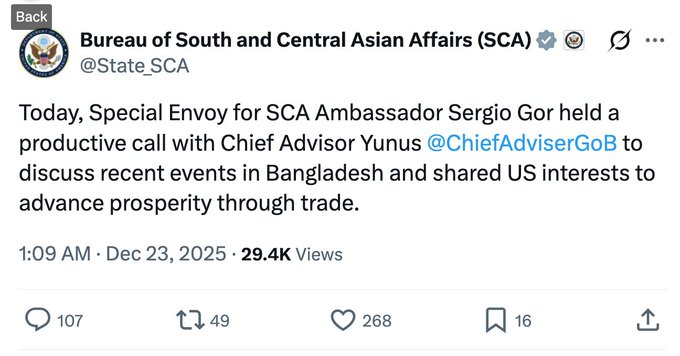
He slammed the incoming US administration under President Trump for overlooking Bangladesh’s turmoil, stating in another post: “Trump has imposed travel bans or restrictions on 39 countries. Yet Bangladesh is conspicuously missing from the list, despite its descent into jihadist chaos and the operation of anti-US extremist networks there. Biden welcomed the August 2024 regime change in Dhaka; Trump now seems to be rewarding it with immunity.”
Chellaney has repeatedly called out media misrepresentations, arguing that labeling political operatives as “student leaders” downplays the severity of the violence.
On December 22, he wrote: “It is unfortunate that sections of the Indian media continue to describe Bangladeshi political operatives as ‘student leaders,’ even when they ceased to be students many years ago. The mislabeling softens the gravity of organised political violence by wrapping it in the language of student politics. Osman Hadi, recently slain, was not a student at all but a university lecturer—someone who taught students. Motaleb Sikder, the latest victim to be shot and wounded, is 42 years old. Persisting with the ‘student leader’ tag is not merely inaccurate; it misleads audiences into mistaking factional violence and regime-backed militancy for student-led protests. Why launder power politics through the romanticised vocabulary of student movements?”
Awami League leader Tofazzel Ronu takes responsibility for family of Dipu Das
Mobocracy At RU: Mob leader Ammar under fire for issuing threats to teachers
NCP leader shot in head over drug business, prostitution in Khulna
Addressing attacks on journalism, he shared on December 20: “Rampage by regime-backed Islamists: ‘It was one of the darkest days for independent journalism in Bangladesh when two of its largest newspapers, The Daily Star and Prothom Alo, were attacked … [It will] erode the country’s image across the globe.'”
In a broader indictment on December 19, Chellaney described Bangladesh as “sliding into open lawlessness,” adding: “Regime-backed militants have torched newspaper offices, stormed Indian diplomatic missions or residences, and lynched a Hindu minority youth by tying him to a tree and burning him alive. As mobs rule the streets, the interim regime headed by a Nobel Peace Prize winner has turned its coercive power inward. The de facto interior minister has ordered police to arrest members of the opposition Awami League even where no cases exist against them, while the law minister has urged courts to deny bail to all such detainees. Together, these directives amount to an assault not only on press freedom but on the rule of law itself. The message is unmistakable: dissent and minorities are no longer safe. In the wake of these attacks, the country’s two leading newspapers have been forced to shut down.”
On December 12, Chellaney also critiqued the regime’s handling of elections and judiciary, stating: “Far from leading Bangladesh toward stability and democratic revival, the unelected Yunus regime has plunged the country deeper into political dysfunction. Its heavy-handed tactics have humiliated even the largely ceremonial president, who has now declared he will resign after the February 12 national election. And by banning the country’s largest political party—which led Bangladesh to independence—the regime has robbed the election of any semblance of legitimacy.”
Hadi Murder Probe: Home adviser knows no whereabouts of suspected killer
Diplomats demand enhanced security amid surge in extremism under Yunus
Rights groups want Nobel Committee to react to violations under Yunus
On November 16, he warned: “Bangladesh is increasingly captive to a mobocracy energised by a Yunus-presided Islamist resurgence. The planned elections next February—instead of delivering the democratic transition Yunus promised when his unelected regime was installed—seem poised to deepen fear and division, pushing Bangladesh further away from any credible path to stability or democratic restoration.”
Chellaney’s commentary extends to regional implications, noting on October 29 a growing defense tie between Bangladesh and Pakistan, which he sees as potentially forming a “Pakistan-Bangladesh-China alignment” with risks for India. He also accused the regime of promoting anti-India narratives, including maps of a “Greater Bangladesh” that encroaches on Indian territory.
These posts, which have garnered thousands of likes and reposts, underscore Chellaney’s view of Bangladesh under Yunus as a failing state where Islamist forces are ascendant, minorities are persecuted, and democratic norms are eroding.
Global Outcry Against State-Sponsored Mobocracy
Chellaney’s criticisms align with a growing international chorus condemning what activists and analysts describe as “state-sponsored mobocracy” under the Yunus government, marked by unchecked violence, repression of dissent, and failure to protect minorities and media. A Bangladesh Nationalist Party (BNP) leader recently labeled the Yunus administration a “failure” in maintaining law and order, stating the country has descended into “mobocracy” following attacks on Indian missions.
Exiled Sheikh Hasina has slammed the interim government as “powerless,” accusing it of normalising violence and placing extremists in power while granting “immunity to hooligans” who target diplomatic sites. Human rights groups have highlighted grave violations, including extrajudicial killings and the suppression of protests, with a UN report from February 2025 documenting “brutal, systematic repression” by security forces.
Interview With The Wall: Sheikh Hasina signals leadership overhaul
Arafat slams Yunus regime for fueling anti-India hysteria in Hadi murder probe
Strategic challenge worries India, but won’t extradite Sheikh Hasina
Activists at the UN Human Rights Council have called out the Yunus regime for escalating violence ahead of elections, warning that Bangladesh risks becoming a “proxy battlefield” against India. Protests have gripped the nation, with pressure mounting from civil servants, teachers, political parties, and the military for Yunus to hold credible elections, as per reports from May 2025. Critics argue that banning political parties like the Awami League contradicts UN recommendations against such measures.
This global scrutiny reflects fears that Bangladesh’s interim rule is fueling instability, with calls for international intervention to restore the rule of law and protect vulnerable communities.
 English
  Bengali